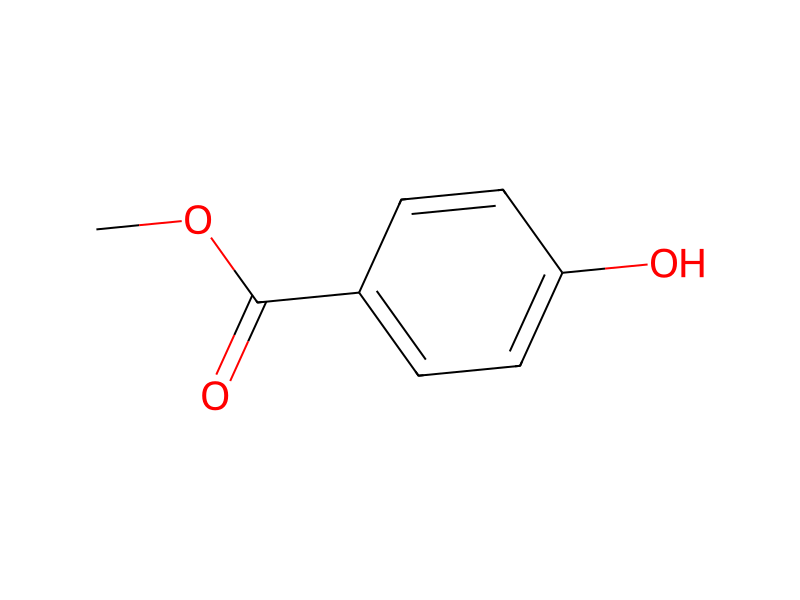
Methylparaben → HCID 10587638, compound
Reaction equation

C1(P(C2C=CC=CC=2)C2C=CC=CC=2)C=CC=CC=1.[OH:20][C:21]1[CH:30]=[CH:29][C:24]([C:25]([O:27][CH3:28])=[O:26])=[CH:23][CH:22]=1.O[CH2:32][CH2:33][CH2:34][N:35]1[CH2:39][CH2:38][CH2:37][CH2:36]1.N(C(OCC)=O)=NC(OCC)=O>C(Cl)Cl>[N:35]1([CH2:34][CH2:33][CH2:32][O:20][C:21]2[CH:22]=[CH:23][C:24]([C:25]([O:27][CH3:28])=[O:26])=[CH:29][CH:30]=2)[CH2:39][CH2:38][CH2:37][CH2:36]1Participants
6





Procedure
A solution of 6.25 g (23.8 mmol) of triphenylphosphine, 3.30 g (21.7 mmol) of methyl 4-hydroxybenzoate, and 2.80 g (21.7 mmol) of 1-(3-hydroxypropyl)pyrrolidine in 100 mL of CH2Cl2 was treated with 3.80 mL (24.1 mmol) of diethyl azodicarboxylate in a dropwise manner. The reaction was stirred at ambient temperature for 16 h and was quenched by the addition of 20 mL of brine. The two layers were separated, and the organic layer was dried over K2CO3 and concentrated to give 6.10 g of an oily solid which was purified by flash chromatography (SiO2; 0-5% MeOH in CH2Cl2) to afford 2.46 g (9.34 mmol; 43%) of the desired product.
Workup
- customwas quenched by the addition of 20 mL of brine
- customThe two layers were separated
- dry with materialthe organic layer was dried over K2CO3
- concentrationconcentrated
Sources & evidence
- ORD record
- ord-40a7e72c46f34009b56d14b81be8eaba
- Source dataset
- uspto-grants-2001_07
- Patent number
- US06265575B1
Reaction notes
Loading…