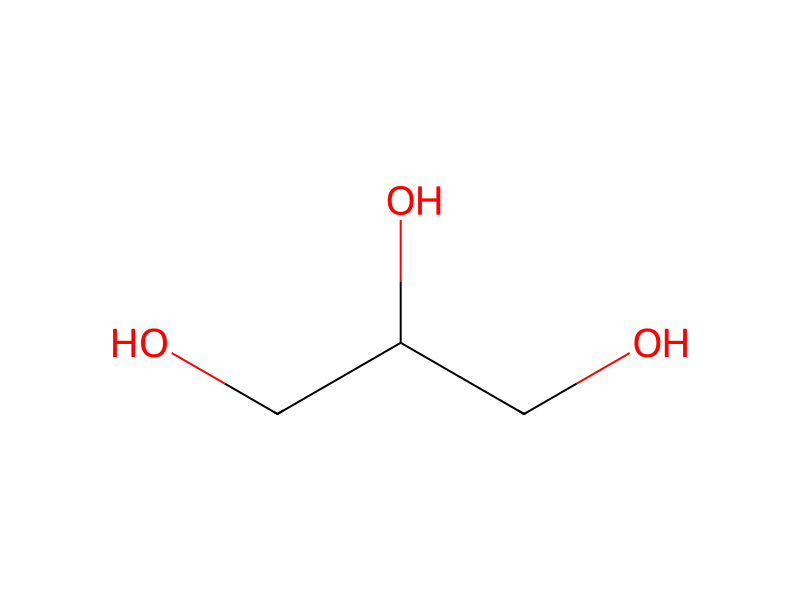
Glycerol → HCID 20469345, compound
Reaction equation

[NH2:1][C:2]1[CH:3]=[C:4](Cl)[CH:5]=[CH:6][C:7]=1[N+:8]([O-:10])=[O:9].[OH:12][CH2:13][CH:14]([CH2:16][OH:17])[OH:15].[OH-].[Na+]>O>[OH:15][CH:14]([CH2:16][OH:17])[CH2:13][O:12][C:4]1[CH:5]=[CH:6][C:7]([N+:8]([O-:10])=[O:9])=[C:2]([NH2:1])[CH:3]=1Participants
5
Reactant 3


Product 1

Reagents, catalysts & solvents 1

Procedure
0.1 mol (17.3 g) of 3-amino-4-nitro-chlorobenzene, which is a known compound [Bios Final Report, 1,147 (1948)], is introduced gradually, at about 120° C., whilst stirring, into 2.4 mols (225 g) of glycerol in which 8.6 g of sodium hydroxide have been dissolved beforehand at about 120° C. When the addition has ended, heating is continued for 21/2 hours and the reaction medium is then poured into 250 g of iced water. The desired product is extracted with ethyl acetate and the ethyl acetate is driven off in vacuo to give 13.6 g of crystalline product. After two recrystallisations from acetonitrile and drying in vacuo, 3-amino-4-nitrophenyl β,γ-dihydroxypropyl ether, which melts at 139° C., is collected.
Workup
- additionis introduced gradually, at about 120° C.
- dissolutionhave been dissolved beforehand at about 120° C
- additionWhen the addition
- temperatureheating
- custom2 hours
- extractionThe desired product is extracted with ethyl acetate
Sources & evidence
- ORD record
- ord-1d48dd56e88b4b4faea52d1d2fb320c0
- Source dataset
- uspto-grants-1984_02
- Patent number
- US04432769
Reaction notes
Loading…