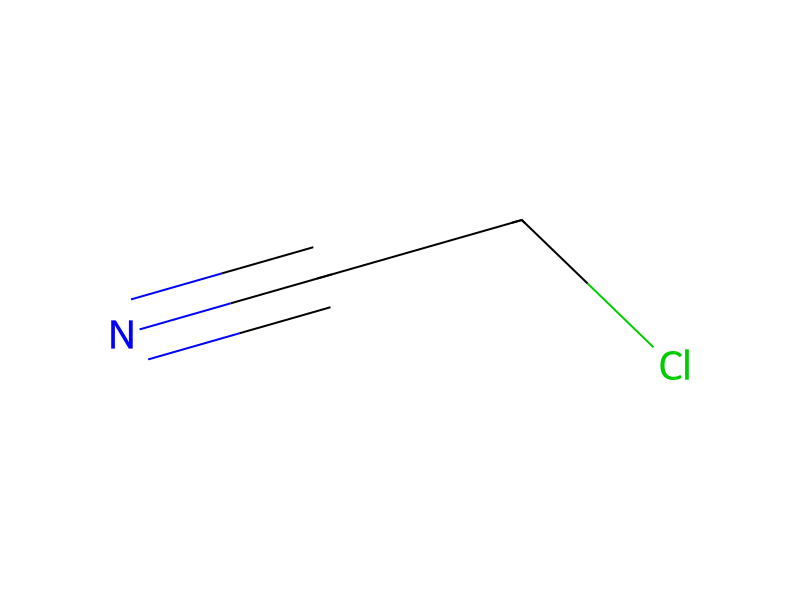
Chloroacetonitrile → HCID 22748760, compound
Reaction equation

[C:1]1([CH:7]([C:17]2[CH:22]=[CH:21][CH:20]=[CH:19][CH:18]=2)[C:8]2[CH:9]=[CH:10][C:11]([C:14]([OH:16])=[O:15])=[N:12][CH:13]=2)[CH:6]=[CH:5][CH:4]=[CH:3][CH:2]=1.[CH2:23]([N:25](CC)CC)[CH3:24].ClCC#N>CC(C)=O>[C:17]1([CH:7]([C:1]2[CH:2]=[CH:3][CH:4]=[CH:5][CH:6]=2)[C:8]2[CH:9]=[CH:10][C:11]([C:14]([O:16][CH2:24][C:23]#[N:25])=[O:15])=[N:12][CH:13]=2)[CH:18]=[CH:19][CH:20]=[CH:21][CH:22]=1Participants
5
Reactant 3


Product 1

Reagents, catalysts & solvents 1

Conditions
- Temperature
- 25 °C
Procedure
Suspend 4.3 g. (0.015 mole) of 5-(diphenylmethyl)-picolinic acid in 100 ml. of acetone with stirring and add 2.3 g. (0.023 mole) of triethylamine. To the resulting solution add dropwise 1.7 g. (0.023 mole) of chloroacetonitrile. Stir the reaction mixture at room temperature (25° C.) for 15 minutes, then reflux for 4 hours. Cool and filter the reaction mixture. Concentrate the filtrate to a residue in vacuo and triturate the residue with hot isopropyl ether to yield the product of this example, yield 3.5 g., m.p. 95°-98° C.
Workup
- additionadd 2.3 g
- additionTo the resulting solution add dropwise 1.7 g
- temperaturereflux for 4 hours
- temperatureCool
- filtrationfilter the reaction mixture
- concentrationConcentrate the filtrate to a residue in vacuo
- customtriturate the residue with hot isopropyl ether
- customto yield the product of this example, yield 3.5 g
Sources & evidence
- ORD record
- ord-d82ba281997a4e9dbc9a82359a13b968
- Source dataset
- uspto-grants-1979_02
- Patent number
- US04138488
Reaction notes
Loading…