Indole → 1H-Indole-1-acetic acid
Reaction equation

Br[CH2:2][C:3]([O:5]CC)=[O:4].[NH:8]1[C:16]2[C:11](=[CH:12][CH:13]=[CH:14][CH:15]=2)[CH:10]=[CH:9]1.[OH-].[Na+]>C1C=CC=CC=1.O.[Br-].C([N+](CCCC)(CCCC)CCCC)CCC>[N:8]1([CH2:2][C:3]([OH:5])=[O:4])[C:16]2[C:11](=[CH:12][CH:13]=[CH:14][CH:15]=2)[CH:10]=[CH:9]1Participants
7
Reactant 3
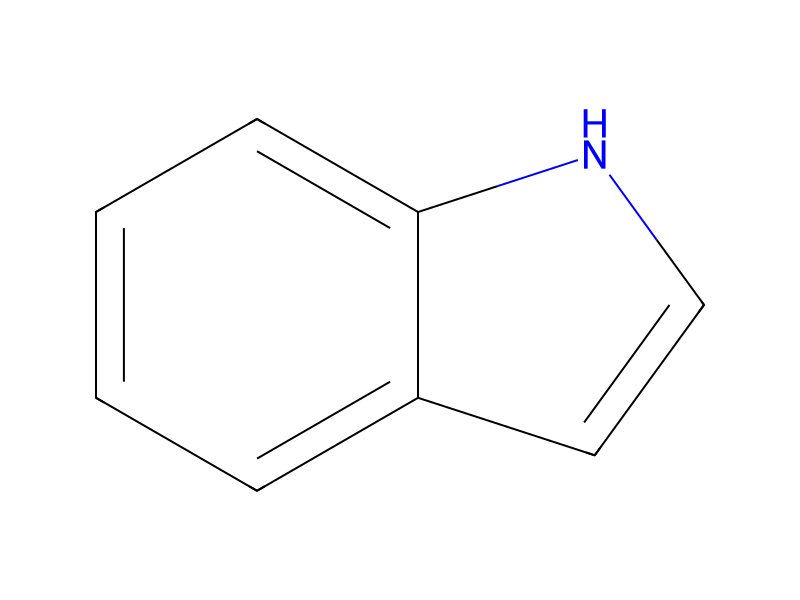


Product 1

Reagents, catalysts & solvents 3



Conditions
- Temperature
- 25 °C
Procedure
To a solution of ethyl 2-bromoacetate (25 g, 0.15 mole) and indole (11.7 g, 0.1 mole) in 100 ml of benzene is added a solution of sodium hydroxide (25 g, 0.626 mole) in 50 ml of water. To the obtained mixture is added tetra-n-butylammonium bromide (1.6 g, 0.5 mmole). The mixture is stirred at 25° C. for 16 hours. The aqueous phase is acidified to pH 3. The organic phase is separated, dried and evaporated to give the title compound in 92% yield. NMR (DMSO-D6) ppm (δ) 5.05 (s, 2); 6.50 (d, 1), 6.9- 7.8 (m, 5).
Workup
- customThe organic phase is separated
- customdried
- customevaporated
Sources & evidence
- ORD record
- ord-f2eaffa804e742cd8533529cb66d5286
- Source dataset
- uspto-grants-1979_02
- Patent number
- US04139703
Reaction notes
Loading…