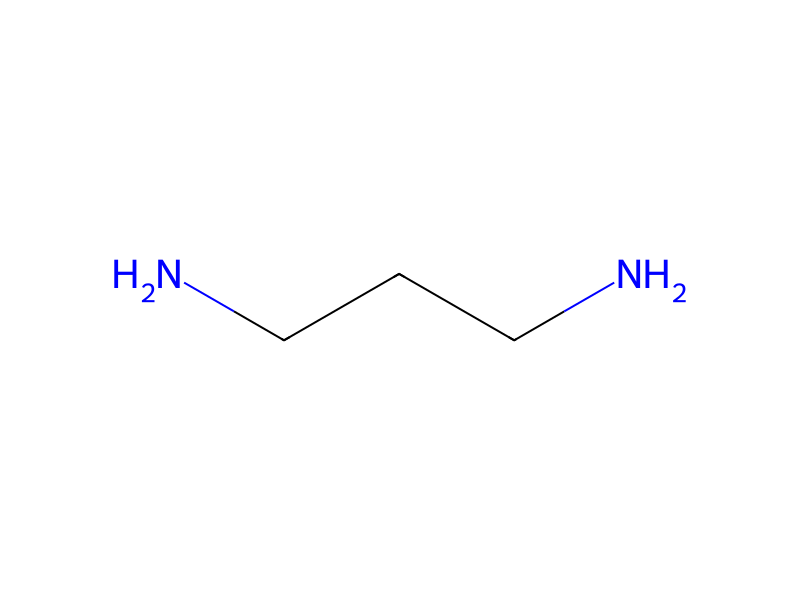
1,3-Propanediamine → Drometrizole
Reaction equation

[N+:1]([C:4]1[CH:9]=[CH:8][CH:7]=[CH:6][C:5]=1[N:10]=[N:11][C:12]1[CH:17]=[C:16]([CH3:18])[CH:15]=[CH:14][C:13]=1[OH:19])([O-])=O.NCCCN.O>C1(C)C(C)=CC=CC=1>[OH:19][C:13]1[CH:14]=[CH:15][C:16]([CH3:18])=[CH:17][C:12]=1[N:11]1[N:10]=[C:5]2[CH:6]=[CH:7][CH:8]=[CH:9][C:4]2=[N:1]1Participants
5
Reactant 3


Product 1

Reagents, catalysts & solvents 1

Procedure
To a 1000-ml. round-bottomed, three-neck flask fitted with a gas inlet tube, stirrer and reflux condenser is added 20.0 grams (0.08 mol) of 2-nitro-2'-hydroxy-5'-methylazobenzene (99.7% pure) dissolved in a solution of 200 ml of xylene. To this solution is added with stirring a mixture of 23.0 grams (0.32 mol) of 1,3-diaminopropane, 100 ml of water and 4 grams (0.02 mol) of cupric acetate. Carbon monoxide gas is then bubbled through the stirred reaction mixture for 15-20 hours with the temperature being maintained at 85°-90° C.
Workup
- customround-bottomed, three-neck flask fitted with a gas inlet tube, stirrer
- temperaturereflux condenser
- additionTo this solution is added
- customCarbon monoxide gas is then bubbled through the stirred reaction mixture for 15-20 hours with the temperature
- temperaturebeing maintained at 85°-90° C.
Sources & evidence
- ORD record
- ord-340013950e0b4c198e6c97bda4f74ba8
- Source dataset
- uspto-grants-1979_02
- Patent number
- US04141903
Reaction notes
Loading…