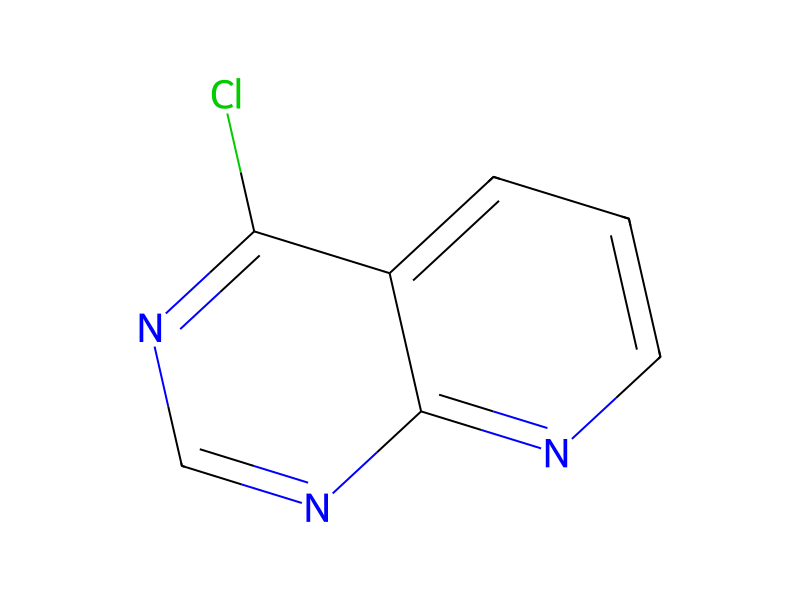
Triethylamine → 4-Chloropyrido[2,3-d]pyrimidine
Reaction equation

[N:1]1[C:6]2[N:7]=[CH:8][CH:9]=[CH:10][C:5]=2[C:4](O)=[N:3][CH:2]=1.C(N(CC)CC)C.P(Cl)(Cl)([Cl:21])=O>>[Cl:21][C:4]1[C:5]2[CH:10]=[CH:9][CH:8]=[N:7][C:6]=2[N:1]=[CH:2][N:3]=1Participants



Procedure
A solution of pyrido[2,3-d]pyrimidin-4-ol (490 mg, 3.33 mMol), triethylamine (4.4 mL, 31.6 mMol), and phosphorous oxychloride (2.8 mL, 30 mMol) was heated at reflux for 2 hours. The mixture was concentrated in-vacuo, and the residue was stripped from methylene chloride (3×50 mL) to remove excess phosphorous oxychloride. The residue was dissolved in ethyl acetate (100 mL), saturated sodium bicarbonate (100 mL) was added carefully, causing vigorous gas evolution, and the mixture was stirred for ten minutes. The layers were separated, the organic phase was washed with saturated sodium bicarbonate (30 mL), water (30 mL), brine (30 mL), dried over sodium sulfate, then concentrated in-vacuo. The residue was purified over silica gel, eluting with 40% ethyl acetate/heptane, to yield 92 mg of a tan solid as product. MS (ES+)=166 (M+H)+. Yield=17%.
Workup
- temperatureat reflux for 2 hours
- concentrationThe mixture was concentrated in-vacuo
- customto remove excess phosphorous oxychloride
- dissolutionThe residue was dissolved in ethyl acetate (100 mL)
- additionsaturated sodium bicarbonate (100 mL) was added carefully
- customThe layers were separated
- washthe organic phase was washed with saturated sodium bicarbonate (30 mL), water (30 mL), brine (30 mL)
- dry with materialdried over sodium sulfate
- concentrationconcentrated in-vacuo
- customThe residue was purified over silica gel
- washeluting with 40% ethyl acetate/heptane
Sources & evidence
- ORD record
- ord-06ff946adc5745c89e8a6f747c76f572
- Source dataset
- uspto-grants-2008_03
- Patent number
- US07338947B2
Reaction notes
Loading…