3-Phenoxybenzyl alcohol → m-Phenoxybenzyl 4-(2-fluorophenyl)-2-isopropyl-3-butenoate
Reaction equation

FC1C=CC=CC=1CC=O.[F:11][C:12]1[CH:17]=[CH:16][CH:15]=[CH:14][C:13]=1[CH:18]=[CH:19][CH:20]([CH:26]([CH3:28])[CH3:27])[C:21]([O:23][CH2:24][CH3:25])=[O:22].FC1C=CC=CC=1C=CC(C(C)C)C(O)=O.[O:45]([C:52]1[CH:53]=C([CH:57]=[CH:58][CH:59]=1)CO)[C:46]1[CH:51]=[CH:50][CH:49]=[CH:48][CH:47]=1>>[F:11][C:12]1[CH:17]=[CH:16][CH:15]=[CH:14][C:13]=1[CH:18]=[CH:19][CH:20]([CH:26]([CH3:27])[CH3:28])[C:21]([O:23][CH2:24][C:25]1[CH:57]=[CH:58][CH:59]=[C:52]([O:45][C:46]2[CH:51]=[CH:50][CH:49]=[CH:48][CH:47]=2)[CH:53]=1)=[O:22]Participants
5
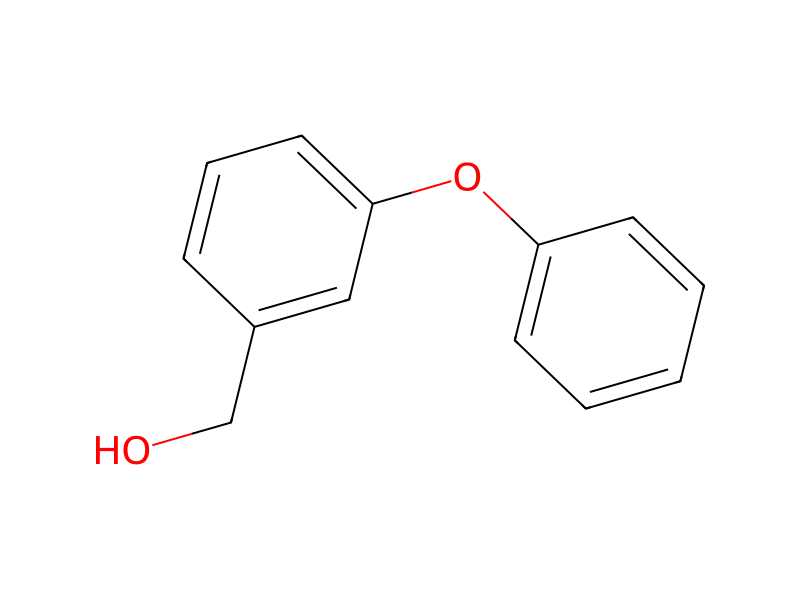


Procedure
2-Fluorophenylacetaldehyde is converted into ethyl 4-(2-fluorophenyl)-2-isopropyl-3-butenoate and hydrolyzed to the acid using the procedure of Example 9. The acid, 4-(2-fluorophenyl)-2-isopropyl-3-butenoic acid, is reacted, via the acid chloride, with m-phenoxybenzyl alcohol to yield m-phenoxybenzyl 4-(2-fluorophenyl)-2-isopropyl-3-butenoate, MS m/e 404.3 (M+). 2-Fluorophenylacetaldehyde is prepared from o-fluoro-β-methoxystyrene via the dimethylacetal using the procedure of Winterfeldt, Berichte 96(12), 3349 (1963).
Sources & evidence
- ORD record
- ord-c17b03b58e274b7f8bdb08cdf1b9b5eb
- Source dataset
- uspto-grants-1980_05
- Patent number
- US04204071
Reaction notes
Loading…