Hydrochloric Acid → Ethyl 2-(4-oxocyclohexyl)acetate
Reaction equation

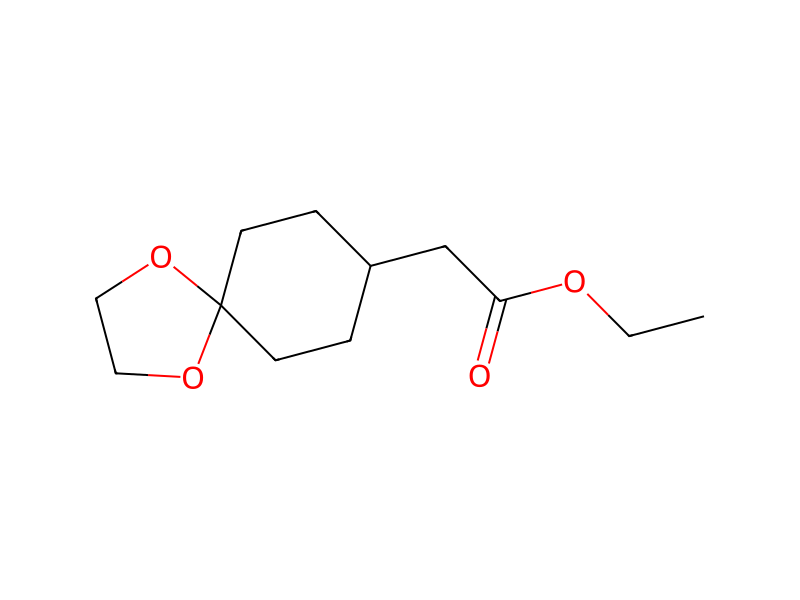
O1[C:5]2([CH2:10][CH2:9][CH:8]([CH2:11][C:12]([O:14][CH2:15][CH3:16])=[O:13])[CH2:7][CH2:6]2)[O:4]CC1.Cl.C([O-])(O)=O.[Na+]>C(#N)C>[O:4]=[C:5]1[CH2:10][CH2:9][CH:8]([CH2:11][C:12]([O:14][CH2:15][CH3:16])=[O:13])[CH2:7][CH2:6]1Participants
5
Reactant 3


Product 1

Reagents, catalysts & solvents 1

Procedure
To a solution of ethyl 2-(1,4-dioxaspiro[4.5]decan-8-yl)acetate (from Step 1, Example 77, 4.71 g, 19.44 mmol) in acetonitrile (45 mL) was added 6N HCl aqueous solution (45 mL). The resulting mixtures was stirred at rt for 2 h and neutralized with solid NaHCO3 to pH 8, extracted with EtOAc. The organic phase was washed with brine, dried over Na2SO4. Filtration and evaporation to dryness gave the ketone product as colorless oil (2.97 g, 78.1%).
Workup
- extractionextracted with EtOAc
- washThe organic phase was washed with brine
- dry with materialdried over Na2SO4
- filtrationFiltration and evaporation to dryness
Sources & evidence
- ORD record
- ord-c228ad51bba74dabb7470fc68aeacb88
- Source dataset
- uspto-grants-2014_12
- Patent number
- US08912169B2
Reaction notes
Loading…