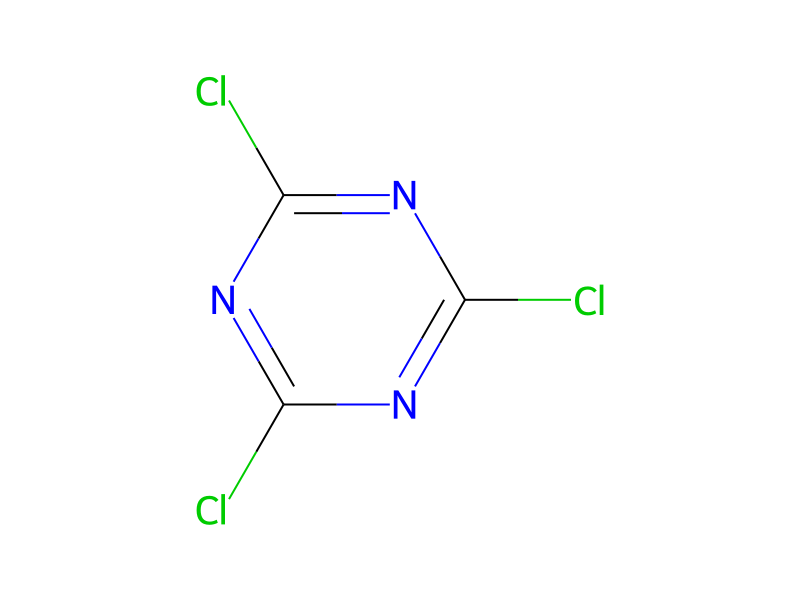
Cyanuric chloride → N-(3-azidopropyl)-4,6-dichloro-1,3,5-triazin-2-amine
Reaction equation

[N:1]1[C:8]([Cl:9])=[N:7][C:5]([Cl:6])=[N:4][C:2]=1Cl.C(N(C(C)C)CC)(C)C.[N:19]([CH2:22][CH2:23][CH2:24][NH2:25])=[N+:20]=[N-:21]>CC(C)=O>[N:19]([CH2:22][CH2:23][CH2:24][NH:25][C:2]1[N:1]=[C:8]([Cl:9])[N:7]=[C:5]([Cl:6])[N:4]=1)=[N+:20]=[N-:21]Participants
5
Reactant 3


Product 1

Reagents, catalysts & solvents 1

Procedure
To a solution of cyanuric chloride (18.42 g, 0.10 mol) in acetone (180 mL) in an ice-water bath was added diisopropylethylamine (DIPEA) (12.92 g, 0.10 mol). 1-azido-3-aminopropane (5.00 g, 0.050 mol) in acetone (50 mL) was added slowly over 2 hours. The reaction was stirred at room temperature overnight. The solvent was removed under reduced pressure. The residue was dissolved in CH2Cl2, washed with water, dried (Na2SO4) and rotary evaporated. The resulting residue was purified by column chromatography on silica gel (eluent CH2Cl2) to give 1 as a white solid (5.62 g, 45%): ESI-MS m/z 248.1 (M+H+) calculated for C6H8Cl2N7 248.0.
Workup
- customThe solvent was removed under reduced pressure
- dissolutionThe residue was dissolved in CH2Cl2
- washwashed with water
- dry with materialdried (Na2SO4) and rotary evaporated
- customThe resulting residue was purified by column chromatography on silica gel (eluent CH2Cl2)
Sources & evidence
- ORD record
- ord-9b9522b2d31340ccb5a87aa75cc45e6f
- Source dataset
- uspto-grants-2014_12
- Patent number
- US08912323B2
Reaction notes
Loading…