N-bromobutanimide → 2-(1-Bromo-ethyl)-4-fluoro-benzonitrile
Reaction equation

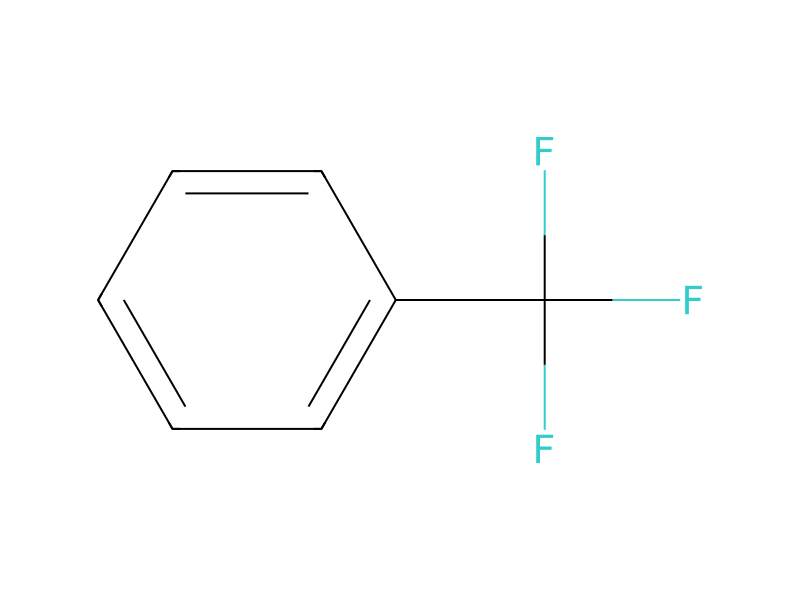
[CH2:1]([C:3]1[CH:10]=[C:9]([F:11])[CH:8]=[CH:7][C:4]=1[C:5]#[N:6])[CH3:2].[Br:12]N1C(=O)CCC1=O>FC(C1C=CC=CC=1)(F)F.N(C(C)(C)C#N)=NC(C)(C)C#N>[Br:12][CH:1]([C:3]1[CH:10]=[C:9]([F:11])[CH:8]=[CH:7][C:4]=1[C:5]#[N:6])[CH3:2]Participants
5



Conditions
- Temperature
- 100 °C
Procedure
To a solution of 2-ethyl-4-fluoro-benzonitrile (prepared according to WO 07039178, page 116) (1.14 g, 7.6 mmol) in trifluoromethyl-benzene (30 mL) was added N-bromosuccinimide (1.63 g, 9.1 mmol, 1.2 eq.) followed by azobisisobutyronitrile (0.025 g, 0.15 mmol, 0.02 eq.). The mixture was heated to 100° C. for 18 hr under an atmosphere of nitrogen and then cooled to room temperature. The mixture was filtered and filtrate partitioned with aqueous sodium sulphite solution (1M, 20 mL). The organic phase was washed with water (20 mL) and then evaporated under reduced pressure to give the title compound as a beige solid (1.62 g, 93%).
Workup
- temperaturecooled to room temperature
- filtrationThe mixture was filtered
- customfiltrate partitioned with aqueous sodium sulphite solution (1M, 20 mL)
- washThe organic phase was washed with water (20 mL)
- customevaporated under reduced pressure
Sources & evidence
- ORD record
- ord-cfb20df412604c48a216f192cf4672dc
- Source dataset
- uspto-grants-2014_12
- Patent number
- US08916593B2
Reaction notes
Loading…