Triethylamine → HCID 18668142, compound
Reaction equation

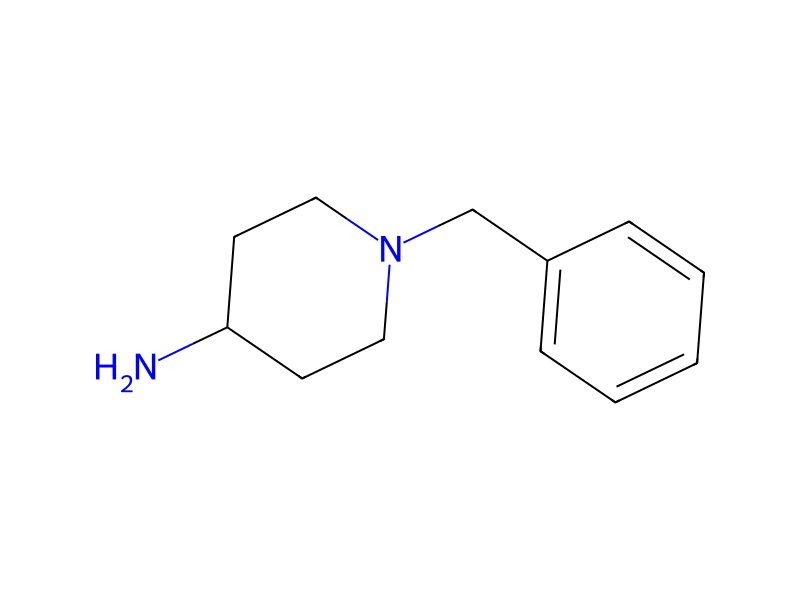
[I:1][C:2]1[CH:10]=[CH:9][C:5]([C:6](Cl)=[O:7])=[CH:4][CH:3]=1.N[CH:12]1[CH2:17][CH2:16][N:15]([CH2:18][C:19]2[CH:24]=[CH:23][CH:22]=[CH:21][CH:20]=2)[CH2:14][CH2:13]1.C([N:27](CC)CC)C>C(Cl)(Cl)Cl>[CH2:18]([N:15]1[CH2:16][CH2:17][CH:12]([C:9]2[CH:10]=[C:2]([I:1])[CH:3]=[CH:4][C:5]=2[C:6]([NH2:27])=[O:7])[CH2:13][CH2:14]1)[C:19]1[CH:24]=[CH:23][CH:22]=[CH:21][CH:20]=1Participants
Reactant 3


Product 1

Reagents, catalysts & solvents 1

Procedure
The 4-iodobenzoyl chloride was dissolved in chloroform (40 mL) and added to a flask containing 4-amino-1-benzyl-piperidine (2.29 g, 12.1 mmol) in chloroform (75 mL) and triethylamine (20 mL). The mixture was stirred at room temperature overnight and the volatiles were removed in vacuo. The resulting slurry was washed with water (100 mL). The organics were dissolved in CHCl3 (100 mL), separated from the aqueous layer and dried over anhydrous Na2SO4. The solvent was removed to give a solid (yield, 86%), m.p. 206° C. m/e=420 (M+). 1H R (δ ppm): 1.47-1.60 (m, 2H, CH2); 1.97-2.11 (m, 2H, CH2); 2.15-2.19 (m, 2H, CH2); 2.81-2.85 (m, 2H, CH2); 3.49 (s, 2H, benzyl CH2); 3.91-3.97 (m, 1H, CH); 5.98-6.00 (d, 1H, NH); 7.22-7.30 (m, 5H arom); 7.43-7.45 (d, 2H, J=8 Hz, para substituted arom); 7.73-7.76 (d, 2 H, J=8 Hz, para substituted arom). 13C NMR (δ ppm): 32.23, 47.19, 52.25, 63.01, 127.14, 128.27, 128.49, 129.14, 134.18, 137.75, 138.14, 166.02)
Workup
- additionadded to a flask
- customthe volatiles were removed in vacuo
- washThe resulting slurry was washed with water (100 mL)
- dissolutionThe organics were dissolved in CHCl3 (100 mL)
- customseparated from the aqueous layer
- dry with materialdried over anhydrous Na2SO4
- customThe solvent was removed
- customto give
- customa solid (yield, 86%), m.p. 206° C. m/e=420 (M+)
Sources & evidence
- ORD record
- ord-c90ad54129b14b98870156a176a5bb0c
- Source dataset
- uspto-grants-1999_06
- Patent number
- US05911970
Reaction notes
Loading…