Triphenylphosphine → 1,1-Dimethylethyl (2S)-2-[[[6-[(acetyloxy)methyl]-3-pyridinyl]oxy]methyl]-1-pyrrolidinecarboxylate
Reaction equation

[C:1]([O:5][C:6]([N:8]1[CH2:12][CH2:11][CH2:10][C@H:9]1[CH2:13][OH:14])=[O:7])([CH3:4])([CH3:3])[CH3:2].[C:15]([O:18][CH2:19][C:20]1[N:25]=[CH:24][C:23](O)=[CH:22][CH:21]=1)(=[O:17])[CH3:16].C1(P(C2C=CC=CC=2)C2C=CC=CC=2)C=CC=CC=1.CCOC(/N=N/C(OCC)=O)=O>C1COCC1>[C:15]([O:18][CH2:19][C:20]1[N:25]=[CH:24][C:23]([O:14][CH2:13][C@@H:9]2[CH2:10][CH2:11][CH2:12][N:8]2[C:6]([O:5][C:1]([CH3:4])([CH3:3])[CH3:2])=[O:7])=[CH:22][CH:21]=1)(=[O:17])[CH3:16]Participants
6
Reactant 4



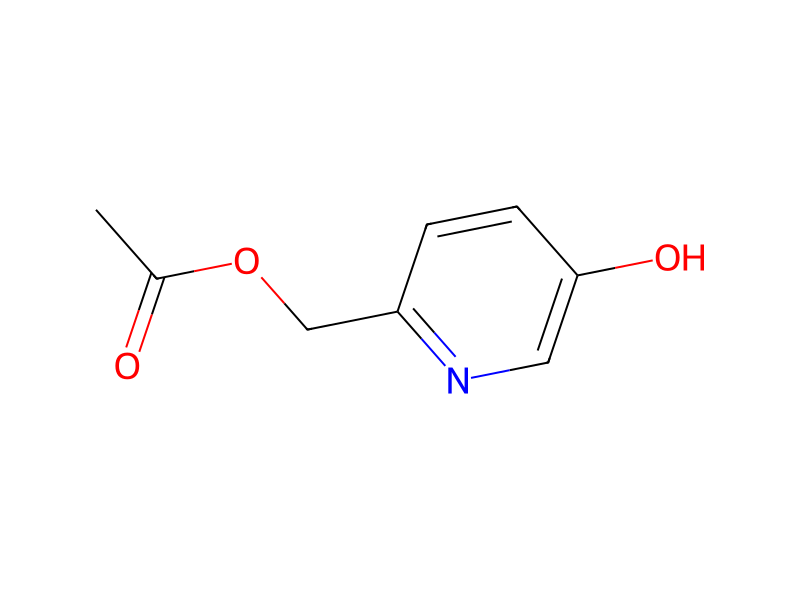
Product 1

Reagents, catalysts & solvents 1

Procedure
A sample of (S)-1-t-butoxycarbonyl-2-pyrrolidinemethanol (1.64 g, 8.18 mmol, prepared as in Example 15a above) and 1.05 g (6.29 mmol) of 6-acetyloxymethyl-3-hydroxypyridine, prepared as described by Deady and Dayhe, Aust. J. Chem., 2565:36 (1983), were reacted with triphenylphosphine and DEAD (8.18 mmol each) in 25 mL of THF according to the procedure of Example 14a. Workup gave 1.90 g of title compound. MS (DCI/NH3) m/e: 309 (M+H)+. 1H NMR (CDCl3, 300 MHz) δ: 8.32-8.28 (m, 1H), 7.33-7.25 (m,.2H), 5.15 (s, 2H), 4.30-3.90 (m, 2H), 3.65-3.25 (m, 3H), 2.13 (s, 3H), 2.10-1.80 (m, 3H), 1.49 (s, 9H).
Sources & evidence
- ORD record
- ord-b7a53cf9f6e747058846b1bf50cd089b
- Source dataset
- uspto-grants-1999_06
- Patent number
- US05914328
Reaction notes
Loading…