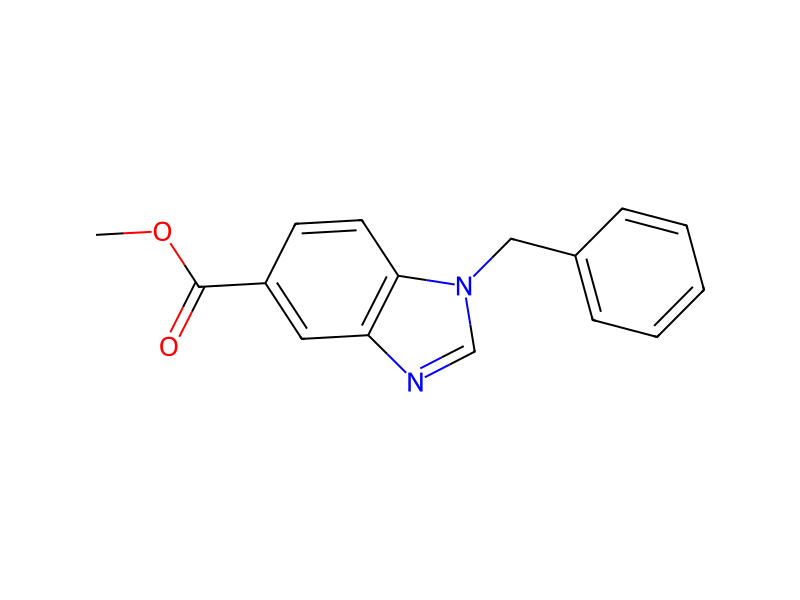
Benzyl Bromide → Methyl 1-benzyl-1H-benzimidazole-5-carboxylate
Reaction equation

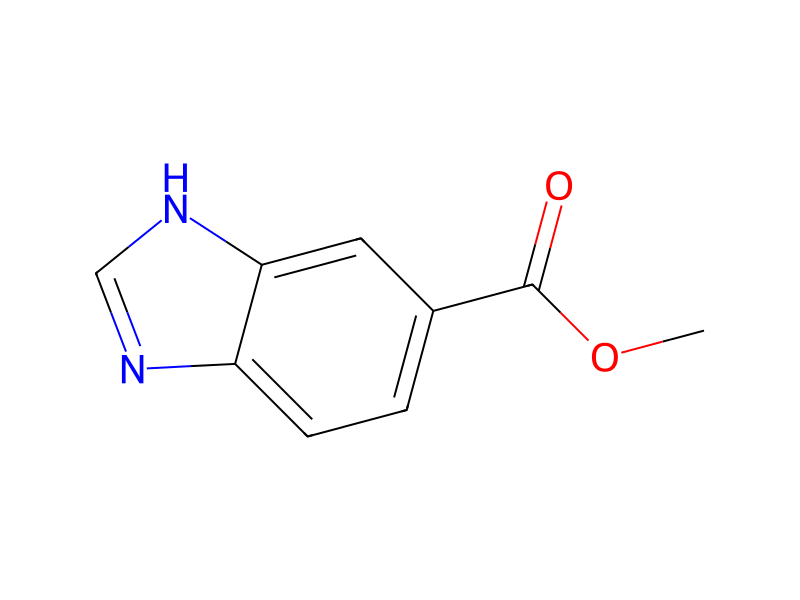
[N:1]1[C:5]2[CH:6]=[CH:7][C:8]([C:10]([O:12][CH3:13])=[O:11])=[CH:9][C:4]=2[NH:3][CH:2]=1.[CH2:14](Br)[C:15]1[CH:20]=[CH:19][CH:18]=[CH:17][CH:16]=1.C(=O)([O-])[O-].[K+].[K+]>CC(C)=O>[CH2:14]([N:1]1[C:5]2[CH:6]=[CH:7][C:8]([C:10]([O:12][CH3:13])=[O:11])=[CH:9][C:4]=2[N:3]=[CH:2]1)[C:15]1[CH:20]=[CH:19][CH:18]=[CH:17][CH:16]=1Participants
5
Reactant 3


Product 1
Reagents, catalysts & solvents 1

Procedure
A mixture of 2.8 g of methyl 5-benzimidazolecarboxylate (prepared as described in Preparation 26), 3.52 g of benzyl bromide, 3 g of potassium carbonate and 50 ml of acetone was stirred for 3 days at room temperature. At the end of this time, the solvent was removed by evaporation under reduced pressure and the residue was mixed with an aqueous solution of sodium chloride, after which it was extracted with ethyl acetate. The extract was dried over anhydrous sodium sulfate, after which the solvent was removed by distillation under reduced pressure. The residue was then recrystallized from a mixture of ethyl acetate and hexane, to give 0.94 g of the title compound, melting at 156°-162° C.
Workup
- customAt the end of this time, the solvent was removed by evaporation under reduced pressure
- additionthe residue was mixed with an aqueous solution of sodium chloride
- extractionafter which it was extracted with ethyl acetate
- dry with materialThe extract was dried over anhydrous sodium sulfate
- customafter which the solvent was removed by distillation under reduced pressure
- customThe residue was then recrystallized from a mixture of ethyl acetate and hexane
Sources & evidence
- ORD record
- ord-ba3e220a895f48f4abeccf9969b9d70b
- Source dataset
- uspto-grants-1999_03
- Patent number
- US05886014
Reaction notes
Loading…