Isobutylene → 9-Borabicyclo[3.3.1]nonane, 9-(2-methylpropyl)-
Reaction equation

[CH3:1][C:2](=[CH2:4])[CH3:3].[CH:5]12[BH:13][CH:9]([CH2:10][CH2:11][CH2:12]1)[CH2:8][CH2:7][CH2:6]2>C1COCC1>[CH3:4][CH:2]([CH3:3])[CH2:1][B:13]1[CH:5]2[CH2:12][CH2:11][CH2:10][CH:9]1[CH2:8][CH2:7][CH2:6]2Participants
Reactant 2

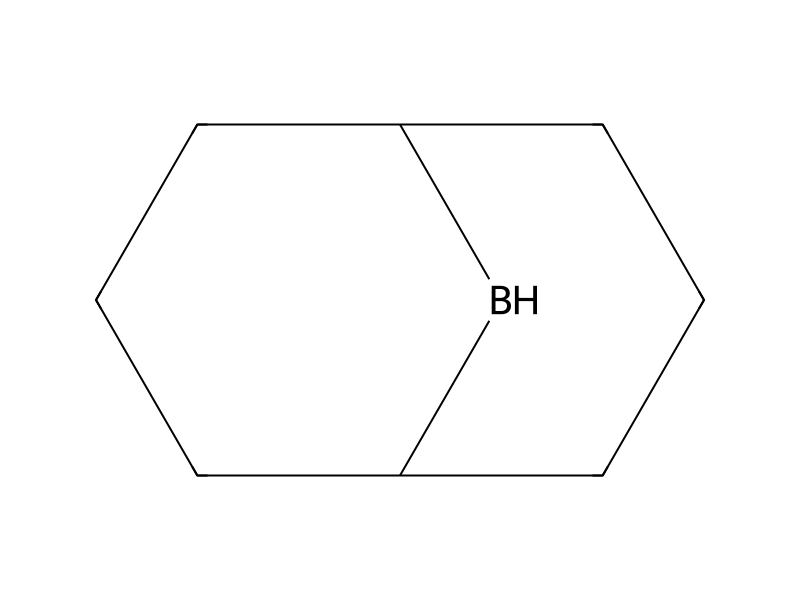
Product 1

Reagents, catalysts & solvents 1

Conditions
- Temperature
- -78 °C
Procedure
To a solution of isobutylene (4.40 g, 78.45 mmol) in 11 ml THF at -78° C., 9-Borabicyclo[3.3.1]nonane (9-BBN) (0.5 M in THF, 157 ml, 78.45 mmol) was added. The mixture was stirred at -78° C. for 3 hours, and then warmed to room temperature and stirred overnight to form 9-(2-Methylpropyl)-9-borabicyclo[3.3.1]nonane (9-isobutyl BBN). In a separate flask, to a solution of 3-bromobenzylalcohol (13.34 g, 71.32 mmol) in 36 ml THF, tetrakis(triphenylphosphine)palladium(0) (2.47 g, 2.14 mmol) and 60 ml 3M NaOH were added. The 9-isobutyl BBN prepared above was then transferred into the flask under argon and the mixture was refluxed for 21 hours. The mixture was cooled with an external ice bath and 18 ml 30% hydrogen peroxide was added. The mixture was stirred for 30 minutes, concentrated to about 100 ml and partitioned between 200 ml each of water and ethyl acetate. The aqueous layer was extracted with ethyl acetate (2×100 ml) and the combined organic extracts were washed with 60 ml brine, dried and concentrated. The residue was chromatographed on silica gel using 9:1 hexane/ethyl acetate to afford compound A (8.16 g, 70%) as a liquid.
Workup
- temperaturewarmed to room temperature
- stirringstirred overnight
Sources & evidence
- ORD record
- ord-e4c67a647af54816b31191bd43728b2f
- Source dataset
- uspto-grants-2000_06
- Patent number
- US06080774
Reaction notes
Loading…