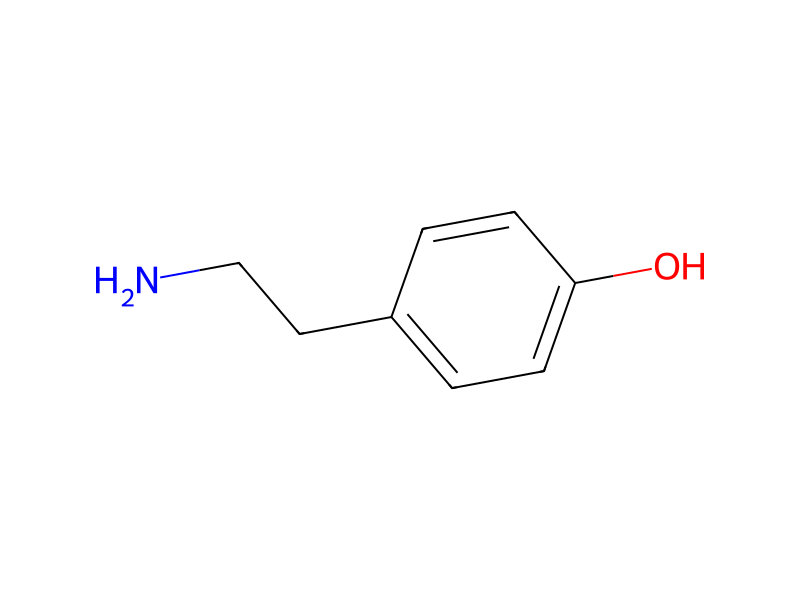
Tyramine → 4-(2-((2-Chloro-9-isopropyl-9H-purin-6-yl)amino)ethyl)phenol
Reaction equation

[Cl:1][C:2]1[N:10]=[C:9]2[C:5]([N:6]=[CH:7][N:8]2[CH:11]([CH3:13])[CH3:12])=[C:4](Cl)[N:3]=1.[NH2:15][CH2:16][CH2:17][C:18]1[CH:23]=[CH:22][C:21]([OH:24])=[CH:20][CH:19]=1.C(N(CC)CC)C>CC(O)C>[Cl:1][C:2]1[N:10]=[C:9]2[C:5]([N:6]=[CH:7][N:8]2[CH:11]([CH3:13])[CH3:12])=[C:4]([NH:15][CH2:16][CH2:17][C:18]2[CH:23]=[CH:22][C:21]([OH:24])=[CH:20][CH:19]=2)[N:3]=1Participants
5
Reactant 3


Product 1

Reagents, catalysts & solvents 1

Procedure
2,6-dichloro-9-isopropyl-9H-purine (500 g) was added in portions to a stirred mixture of tyramine (593 g), triethylamine (262 g), and i-PrOH (5.0 L) at 50° C. The mixture was stirred at that temperature for 4 hr, then the reaction mixture was concentrated. The residue was taken up in isopropyl acetate (6.0 L) and was washed with 20% citric acid solution (2.0 L) and water (2.0 L). The organic layer was concentrated to dryness, then was taken up in ethanol (2.0 L) and again concentrated to dryness. The crude solid was crystallized from ethanol (3.2 L) to provide the title compound as a solid.
Workup
- concentrationthe reaction mixture was concentrated
- washwas washed with 20% citric acid solution (2.0 L) and water (2.0 L)
- concentrationThe organic layer was concentrated to dryness
- concentrationagain concentrated to dryness
- customThe crude solid was crystallized from ethanol (3.2 L)
Sources & evidence
- ORD record
- ord-21a1f1f5ab624e4c9d0d538b6c42ea35
- Source dataset
- uspto-grants-2015_01
- Patent number
- US08927281B2
Reaction notes
Loading…