Water → HCID 67500537, compound
Reaction equation
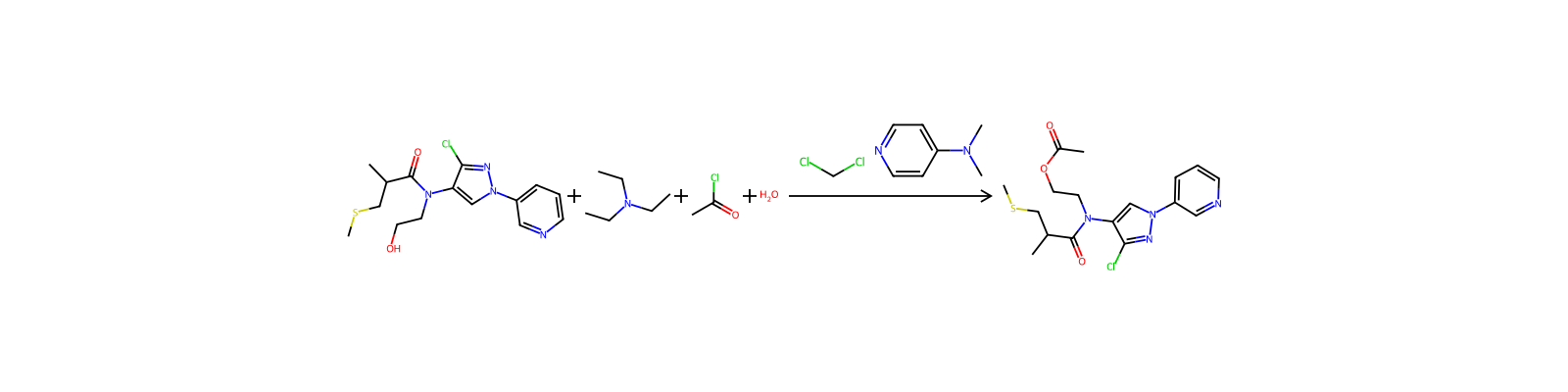
[Cl:1][C:2]1[C:6]([N:7]([CH2:15][CH2:16][OH:17])[C:8](=[O:14])[CH:9]([CH3:13])[CH2:10][S:11][CH3:12])=[CH:5][N:4]([C:18]2[CH:19]=[N:20][CH:21]=[CH:22][CH:23]=2)[N:3]=1.C(N(CC)CC)C.[C:31](Cl)(=[O:33])[CH3:32].O>ClCCl.CN(C)C1C=CN=CC=1>[C:31]([O:17][CH2:16][CH2:15][N:7]([C:6]1[C:2]([Cl:1])=[N:3][N:4]([C:18]2[CH:19]=[N:20][CH:21]=[CH:22][CH:23]=2)[CH:5]=1)[C:8](=[O:14])[CH:9]([CH3:13])[CH2:10][S:11][CH3:12])(=[O:33])[CH3:32]Participants







Procedure
To a solution of N-(3-chloro-1-(pyridin-3-yl)-1H-pyrazol-4-yl)-N-(2-hydroxyethyl)-2-methyl-3-(methylthio)propanamide (0.045 g, 0.127 mmol) in dichloromethane (1.27 ml) was added N,N-dimethylpyridin-4-amine (0.023 g, 0.190 mmol) and triethylamine (0.019 g, 0.190 mmol) followed by acetyl chloride (0.015 g, 0.190 mmol). The reaction was stirred at room temperature overnight. Water was added and the mixture was extracted with dichloromethane. The combined organic phases were concentrated and chromatographed (0-100% ethyl acetate/hexanes) to give 2-(N-(3-chloro-1-(pyridin-3-yl)-1H-pyrazol-4-yl)-2-methyl-3-(methylthio)propanamido)ethyl acetate as a yellow oil (0.015 g, 0.034 mmol, 26.8%): IR (thin film) 1739, 1669 cm−1; 1H NMR (400 MHz, CDCl3) δ 8.97 (d, J=2.3 Hz, 1H), 8.64 (dd, J=4.7, 1.4 Hz, 1H), 8.15 (s, 1H), 8.04 (ddd, J=8.3, 2.7, 1.4 Hz, 1H), 7.47 (ddd, J=8.3, 4.8, 0.7 Hz, 1H), 4.50-3.40 (m, 4H), 2.84 (dd, J=12.7, 8.9 Hz, 1H), 2.78-2.63 (m, 1H), 2.46 (dd, J=12.7, 5.4 Hz, 1H), 2.03 (s, 3H), 2.01 (s, 3H), 1.16 (d, J=6.6 Hz, 3H); ESIMS m/z 398 ([M+H]+).
Workup
- extractionthe mixture was extracted with dichloromethane
- concentrationThe combined organic phases were concentrated
- customchromatographed (0-100% ethyl acetate/hexanes)
Sources & evidence
- ORD record
- ord-2782849829f74178855fb8d7d9a68bc8
- Source dataset
- uspto-grants-2015_01
- Patent number
- US08937083B2
Reaction notes
Loading…