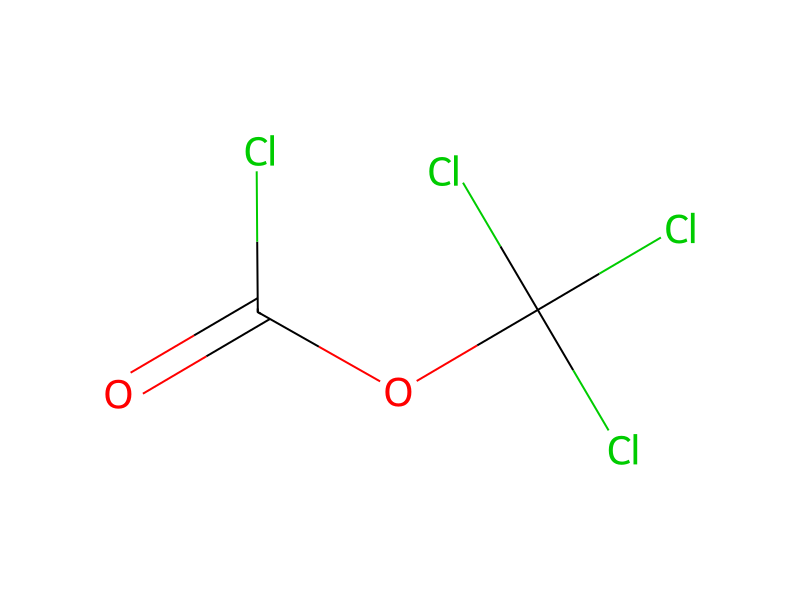
Diphosgene → HCID 66870786, compound
Reaction equation

FC(F)(F)[C:3]([O-])=[O:4].[OH:8][C@H:9]1[CH2:14][NH:13][C@@H:12]([C:15]([O:17][CH2:18][C:19]2[CH:24]=[CH:23][C:22]([N+:25]([O-:27])=[O:26])=[CH:21][CH:20]=2)=[O:16])[CH2:11][CH2:10]1.O=C(Cl)OC(Cl)(Cl)Cl>ClCCl>[O:4]=[C:3]1[N:13]2[CH2:14][C@H:9]([CH2:10][CH2:11][C@@H:12]2[C:15]([O:17][CH2:18][C:19]2[CH:24]=[CH:23][C:22]([N+:25]([O-:27])=[O:26])=[CH:21][CH:20]=2)=[O:16])[O:8]1Participants
5
Reactant 3


Product 1

Reagents, catalysts & solvents 1

Conditions
- Temperature
- 0 °C
Procedure
0.802 g (2.034 mmoles) of the trifluoroacetate of cis(4-nitrophenyl)methyl 5-hydroxy-2-piperidinecarboxylate (described in Rec. Trav. Chim. (1959), 78, 648-658), of molecular formula C13H16N2O5,CF3CO2H (M=394.303 g) is introduced under a nitrogen atmosphere, into 40 ml of dichloromethane and the reaction medium is cooled down to 0° C. 0.135 ml of diphosgene is added. Agitation is carried out for 15 minutes at 0° C., the temperature is left to rise to ambient temperature and agitation is continued for 35 minutes.
Workup
- waitthe temperature is left
- customto rise to ambient temperature
- waitagitation is continued for 35 minutes
Sources & evidence
- ORD record
- ord-d91fabb7d6024ba8b40ffb239a736bf7
- Source dataset
- uspto-grants-2009_11
- Patent number
- US07612087B2
Reaction notes
Loading…