Water → HCID 178519429, compound
Reaction equation

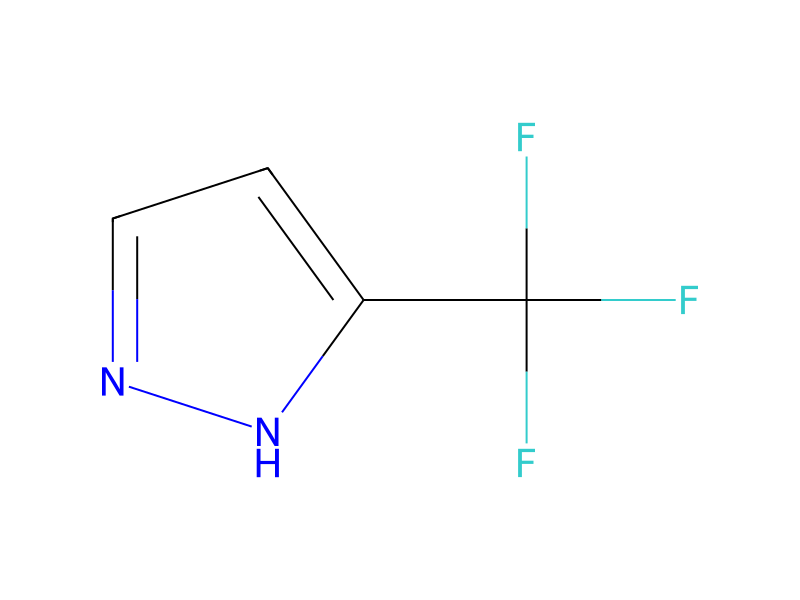
[F:1][C:2]([F:9])([F:8])[C:3]1[CH:7]=[CH:6][NH:5][N:4]=1.[Cl:10][C:11]1[CH:18]=[C:17](F)[CH:16]=[CH:15][C:12]=1[CH:13]=[O:14].C(=O)([O-])[O-].[K+].[K+].O>CN(C)C=O>[Cl:10][C:11]1[CH:18]=[C:17]([C:7]2[C:3]([C:2]([F:9])([F:8])[F:1])=[N:4][NH:5][CH:6]=2)[CH:16]=[CH:15][C:12]=1[CH:13]=[O:14]Participants
6
Reactant 4



Product 1

Reagents, catalysts & solvents 1

Procedure
4.08 g (30.0 mmol) of 3-trifluoromethylpyrazol, 4.75 mmol (30.0 mmol) of 2-chloro-4-fluorobenzaldehyde and 4.14 g (30.0 mmol) of potassium carbonate in 30 ml of N,N-dimethylformamide were stirred at 60° C. for 2 hours. After cooling to room temperature, the reaction mixture was poured into 100 ml of water, and the organic matters were extracted with 50 ml of ethyl acetate twice. The ethyl acetate layers were combined, washed with 50 ml of water twice and dried over anhydrous magnesium sulfate, and the ethyl acetate was distilled off under reduced pressure. The residue afforded 7.18 g of 2-chloro-4-(3-trifluoromethylpyrazolyl)benzaldehyde (yield 87.2%) as a pale yellow powder, after washed with n-hexane.
Workup
- extractionthe organic matters were extracted with 50 ml of ethyl acetate twice
- washwashed with 50 ml of water twice
- dry with materialdried over anhydrous magnesium sulfate
- distillationthe ethyl acetate was distilled off under reduced pressure
Sources & evidence
- ORD record
- ord-272c709cfdd8448a94e6137c6a70871b
- Source dataset
- uspto-grants-2009_11
- Patent number
- US07612105B2
Reaction notes
Loading…