Glycolide → HCID 6453016, compound
Reaction equation

[CH2:1]1[O:8]C(=O)C[O:4][C:2]1=[O:3].[CH3:9][C@@H:10]1[O:17]C(=O)[C@H](C)[O:13][C:11]1=[O:12]>O>[C:2]([OH:4])(=[O:3])[CH2:1][OH:8].[C:11]([OH:13])(=[O:12])[C@H:10]([CH3:9])[OH:17]Participants
Reactant 2

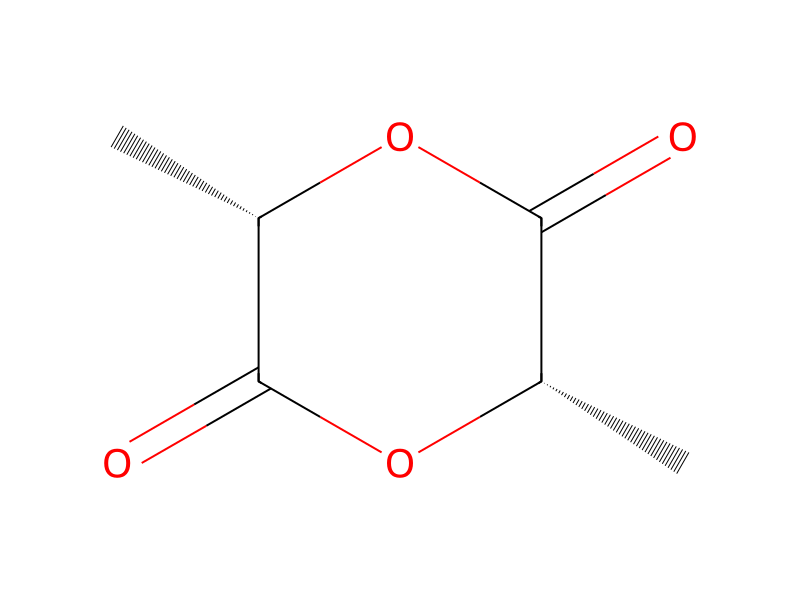
Product 1

Reagents, catalysts & solvents 1

Conditions
- Temperature
- 170 °C
Procedure
An operation was conducted in the same manner as in Example 10 except that 22,050 g (glycolic acid: 50 ppm, glycolic acid dimer: 380 ppm, water: 20 ppm; overall proton concentration of impurities: 0.053 mol %) of glycolide prepared by the same process as in Synthesis Example 1 and 450 g (lactic acid: 0 ppm, lactic acid dimer: 270 ppm, water: 8 ppm; overall proton concentration of impurities: 0.030 mol %) of L-lactide were used as monomers, 1.45 g [in view of the amount (0.27 g) of water (moisture) contained in an atmosphere within the container] of water were added to control the overall proton concentration (set proton concentration) to 0.105 mol %, a heat transfer oil heated to 170° C. was circulated in the jacket part of the polymerization equipment, and the temperature of the upper and lower plates was also kept to 170° C. to hold the contents for 24 hours. After completion of the polymerization, the yield of bulk matter of a poly(glycolic acid/L-lactic acid) copolymer formed was almost 100%. The bulk matter was ground by a grinder, and the physical properties of the ground product were measured. The results are shown in Table 5.
Workup
- additionwere added
- concentrationthe overall proton concentration (set proton concentration) to 0.105 mol %
- customwas also kept to 170° C.
- customfor 24 hours
- customAfter completion of the polymerization
Sources & evidence
- ORD record
- ord-a2795be714044ed88a38ccfdd18f1a47
- Source dataset
- uspto-grants-2009_11
- Patent number
- US07622546B2
Reaction notes
Loading…