p-Toluenesulfonic acid → p-[(p-n-Heptylbenzyliden)amino]benzonitrile
Reaction equation

[NH2:1][C:2]1[CH:9]=[CH:8][C:5]([C:6]#[N:7])=[CH:4][CH:3]=1.[CH2:10]([C:17]1[CH:24]=[CH:23][C:20]([CH:21]=O)=[CH:19][CH:18]=1)[CH2:11][CH2:12][CH2:13][CH2:14][CH2:15][CH3:16].C1(C)C=CC(S(O)(=O)=O)=CC=1>C1C=CC=CC=1>[CH2:10]([C:17]1[CH:24]=[CH:23][C:20]([CH:21]=[N:1][C:2]2[CH:9]=[CH:8][C:5]([C:6]#[N:7])=[CH:4][CH:3]=2)=[CH:19][CH:18]=1)[CH2:11][CH2:12][CH2:13][CH2:14][CH2:15][CH3:16]Participants
5
Reactant 3

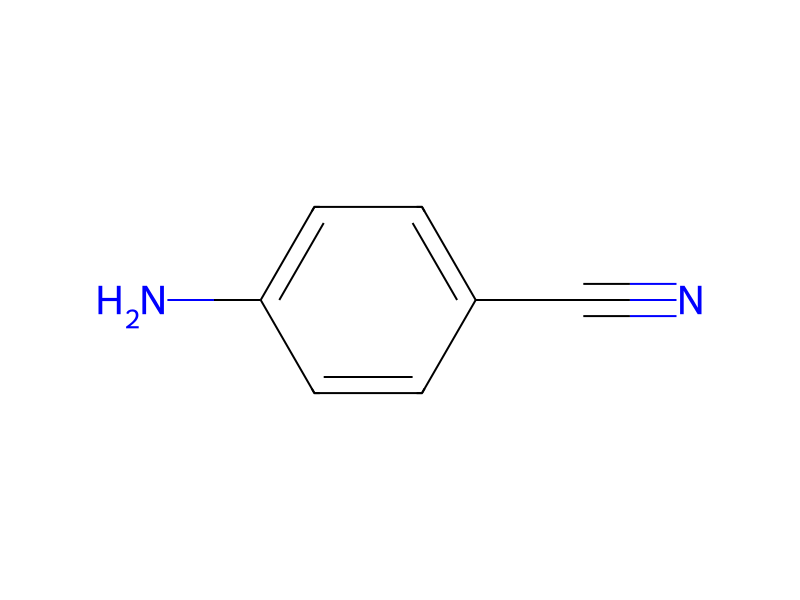

Product 1

Reagents, catalysts & solvents 1

Procedure
A mixture of 5.9 g. of p-aminobenzonitrile and 10.2 g. of p-n-heptylbenzaldehyde in 100 ml. of benzene is treated with 150 mg. of p-toluenesulfonic acid and reacted as described in Example 1. After evaporation, there remain 15.4 g. of a yellow oil which crystallizes with cooling. Purification is carried out by several recrystallizations from isopropanol as described in Example 1. The p-[(p-n-heptylbenzyliden)amino]benzonitrile which is obtained has a melting point of 32.7°-33.0° C. and a clearing point of 72.3° C. UV (ethanol): ε281 = 24100 (shoulder at 310 nm). The nuclear magnetic resonance, mass spectrum, infrared and microanalysis data confirm the structure.
Workup
- additionA mixture of 5.9 g
- customAfter evaporation, there
- customof a yellow oil which crystallizes
- temperaturewith cooling
- customPurification
- customis carried out by several recrystallizations from isopropanol
Sources & evidence
- ORD record
- ord-646fdfa79aff4dde8c430bdf842821c8
- Source dataset
- uspto-grants-1977_11
- Patent number
- US04058477
Reaction notes
Loading…