Methanol → Quinacridone
Reaction equation

[NH:1]([C:8]1[CH:16]=[C:15]([C:17](O)=[O:18])[C:14]([NH:20][C:21]2[CH:26]=[CH:25][CH:24]=[CH:23][CH:22]=2)=[CH:13][C:9]=1[C:10](O)=[O:11])[C:2]1[CH:7]=[CH:6][CH:5]=[CH:4][CH:3]=1.P(=O)(O)(O)O.CO>O.[Fe].[Cl-].[Na+]>[CH:24]1[CH:25]=[C:26]2[C:17]([C:15]3[C:14]([NH:20][C:21]2=[CH:22][CH:23]=1)=[CH:13][C:9]1[C:10]([C:7]2[C:2]([NH:1][C:8]=1[CH:16]=3)=[CH:3][CH:4]=[CH:5][CH:6]=2)=[O:11])=[O:18]Participants
Reactant 3



Product 1
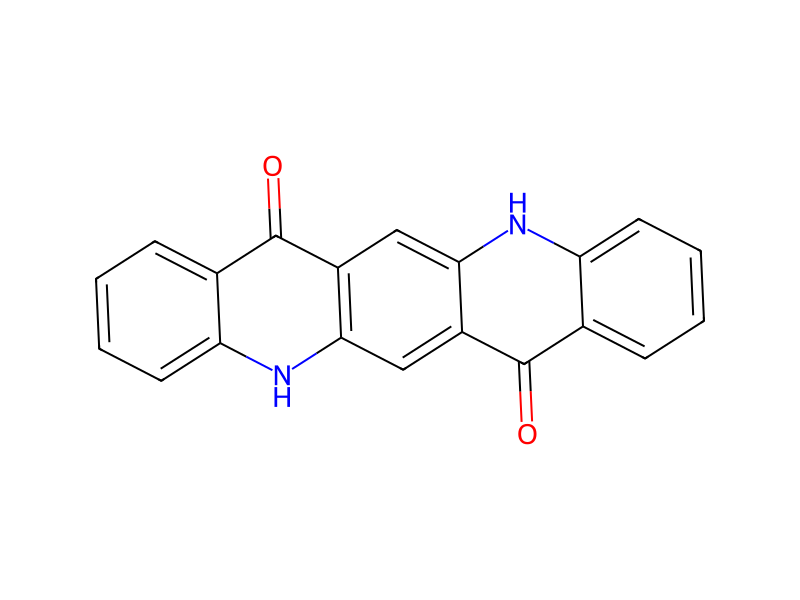
Reagents, catalysts & solvents 3



Conditions
- Temperature
- 85 °C
Procedure
To 270 g of polyphosphoric acid (117.4% phosphoric acid) heated at 80°-95° C. was added 0.25 g (4.3 mmole) of sodium chloride followed by 50 g (0.144 mole) of 2,5-dianilinoterephthalic acid having an iron content of less than 100 ppm. The mixture was heated at 120°-125° C. for four hours. After the viscous solution was cooled to 90°-95° C., the acid strength was adjusted to 107% by the dropwise addition of 75% phosphoric acid. The resultant melt was stirred for 20 minutes and then slowly poured into 400 g of methanol at 35° C. The temperature of the resultant slurry was allowed to rise during the addition to about 64° C., with the temperature being controlled during addition by external cooling and adjustment of melt addition rate. The slurry was heated at reflux (68°-72° C.) for one hour, diluted with 600 g of water, and stirred for 30 minutes. The solid component was collected by filtration and washed with water until acid-free. The resultant presscake was reslurried in 1000 g of aqueous sodium hydroxide and heated at about 85° C. The slurry was cooled, filtered, and washed with water until free of alkali, then reslurried in water and treated with aqueous sodium hydroxide containing naphthenic acid. The resultant slurry was heated at about 140°-145° C. in a closed system (e.g., a pressure reactor), cooled, acidified to pH 4.5-5.0 with phosphoric acid, and stirred. The solid component was collected by filtration and washed with water. The wet cake can be oven dried or used as is for specific applications. Here, the wet cake was dried in an oven at 60° C. to give about 40 g of quinacridone as a brilliant violet solid.
Workup
- temperatureThe mixture was heated at 120°-125° C. for four hours
- temperatureAfter the viscous solution was cooled to 90°-95° C.
- additionto rise during the addition to about 64° C., with the temperature
- additionbeing controlled during addition
- temperatureby external cooling
- additionadjustment of melt addition rate
- temperatureThe slurry was heated
- temperatureat reflux (68°-72° C.) for one hour
- stirringstirred for 30 minutes
- filtrationThe solid component was collected by filtration
- washwashed with water until acid-free
- temperatureThe slurry was cooled
- filtrationfiltered
- washwashed with water until free of alkali,
- additiontreated with aqueous sodium hydroxide
- additioncontaining naphthenic acid
- temperatureThe resultant slurry was heated at about 140°-145° C. in a closed system (e.g., a pressure reactor)
- temperaturecooled
- stirringstirred
- filtrationThe solid component was collected by filtration
- washwashed with water
- customdried
- customHere, the wet cake was dried in an oven at 60° C.
Sources & evidence
- ORD record
- ord-6251fe292cf740a780f1031210bb6389
- Source dataset
- uspto-grants-1996_03
- Patent number
- US05496405
Reaction notes
Loading…