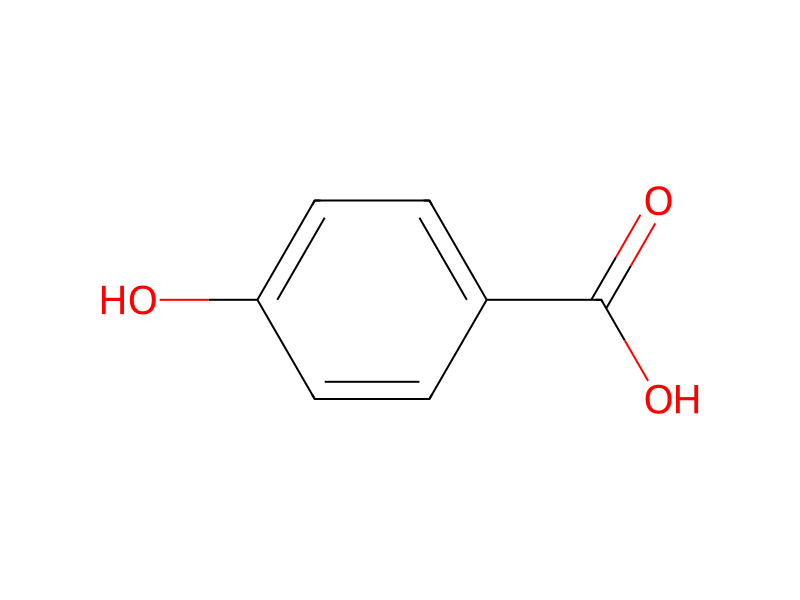
4-Hydroxybenzoic Acid → 4-(Benzyloxy)benzoic acid
Reaction equation

[OH:1][C:2]1[CH:10]=[CH:9][C:5]([C:6]([OH:8])=[O:7])=[CH:4][CH:3]=1.[CH2:11](Cl)[C:12]1[CH:17]=[CH:16][CH:15]=[CH:14][CH:13]=1.C(=O)([O-])[O-].[K+].[K+].[OH-].[Na+].Cl>CC(C)=O.O.C(O)C>[CH2:11]([O:1][C:2]1[CH:10]=[CH:9][C:5]([C:6]([OH:8])=[O:7])=[CH:4][CH:3]=1)[C:12]1[CH:17]=[CH:16][CH:15]=[CH:14][CH:13]=1Participants








Procedure
A suspension of p-hydroxybenzoic acid (200 g, 1.2 mole), benzyl chloride (190 g, 1.5 mole) and potassium carbonate (165 g, 1.2 mole) in acetone (1200 ml) was reacted with stirring for 12 hours under reflux. After cooling, the precipitate was filtered off, and the filtrate was concentrated until 400 ml. H2O (1 l) was added with stirring to the residue and the mixture was allowed to stand. The organic layer was separated, and concentrated, and the residue was added to a solution of NaOH (60 g, 1.5 mole) in H2O (1 l) and ethanol (500 ml), followed by stirring for 4 hours to be dissolved. Then conc. hydrochloric acid (200 ml) was added to make pH 1. The precipitate was filtered, washed with H2O and with ethanol, and dried to give 195 g of 4-benzyloxybenzoic acid as white crystals having a m.p. of 191.2°-192.6° C.
Workup
- customwas reacted
- temperatureunder reflux
- temperatureAfter cooling
- filtrationthe precipitate was filtered off
- concentrationthe filtrate was concentrated until 400 ml
- additionH2O (1 l) was added
- stirringwith stirring to the residue
- customThe organic layer was separated
- concentrationconcentrated
- stirringby stirring for 4 hours
- dissolutionto be dissolved
- filtrationThe precipitate was filtered
- washwashed with H2O and with ethanol
- customdried
Sources & evidence
- ORD record
- ord-39ca7a31a2bd4c8ba42aba9afac41a0c
- Source dataset
- uspto-grants-1996_03
- Patent number
- US05498748
Reaction notes
Loading…