1-Chloro-4-nitrobenzene → 4-Nitrodiphenylamine
Reaction equation

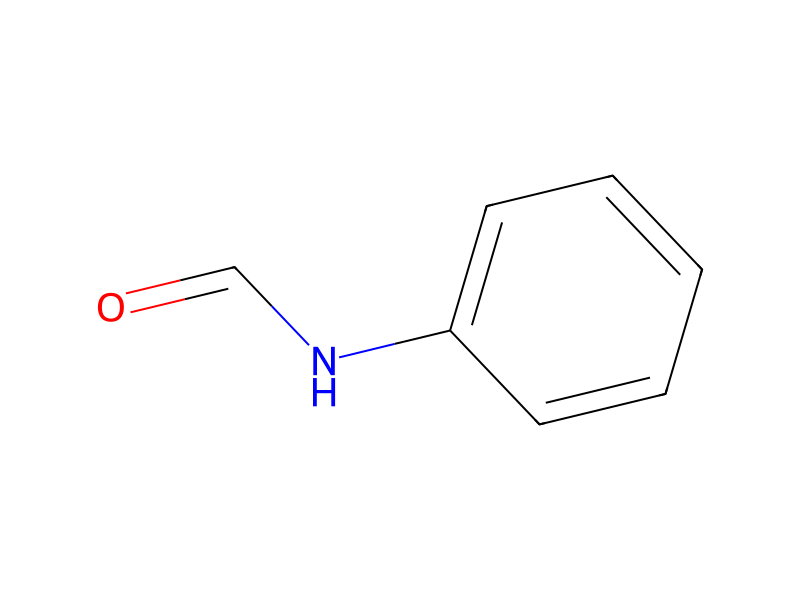
C([NH:3][C:4]1[CH:9]=[CH:8][CH:7]=[CH:6][CH:5]=1)=O.[Na].C(NC1C=CC=CC=1)=O.[K].C(NC1C=CC=CC=1)=O.[N+:30]([C:33]1[CH:38]=[CH:37][C:36](Cl)=[CH:35][CH:34]=1)([O-:32])=[O:31]>>[CH:7]1[CH:8]=[CH:9][C:4]([NH:3][C:36]2[CH:37]=[CH:38][C:33]([N+:30]([O-:32])=[O:31])=[CH:34][CH:35]=2)=[CH:5][CH:6]=1Participants
5



Procedure
Into a suitable reactor is charged 64.4 parts by weight (0.45 mole) of sodium formanilide and 8.0 parts by weight (0.05 mole) of potassium formanilide to give a 90/10 ratio of the salts. In addition, there is added 23.4 parts by weight (0.193 mole) of formanilide and 60.6 parts by weight (0.385) of p-nitrochlorobenzene. The mixture is heated and stirred for 1.5 hours at 152°-160° C. The product is isolated as described in Example 1 to obtain 75.1 parts by weight or 93% yield of 4-nitrodiphenylamine. Conversion of p-nitrochlorobenzene is 98.4%.
Workup
- customto give a 90/10 ratio of the salts
- temperatureThe mixture is heated
- customThe product is isolated
Sources & evidence
- ORD record
- ord-f3cc208d4f4e41c9942b1c7ab590eca0
- Source dataset
- uspto-grants-1980_02
- Patent number
- US04187249
Reaction notes
Loading…