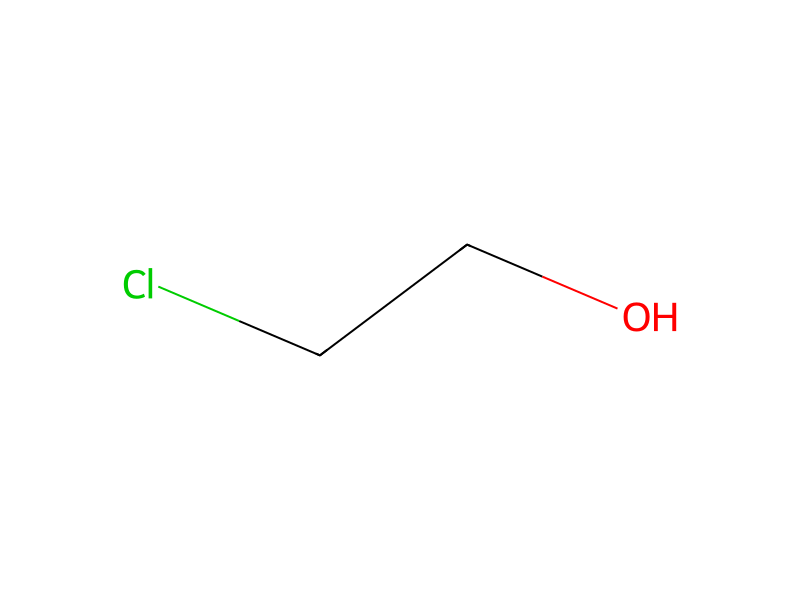
2-Chloroethanol → 3(2H)-Pyridazinone, 6-(2-chlorophenoxy)-2-(2-hydroxyethyl)-
Reaction equation

[Na].[Cl:2][C:3]1[CH:16]=[CH:15][CH:14]=[CH:13][C:4]=1[O:5][C:6]1[CH:7]=[CH:8][C:9](=[O:12])[NH:10][N:11]=1.Cl[CH2:18][CH2:19][OH:20]>C(O)CCC>[OH:20][CH2:19][CH2:18][N:10]1[C:9](=[O:12])[CH:8]=[CH:7][C:6]([O:5][C:4]2[CH:13]=[CH:14][CH:15]=[CH:16][C:3]=2[Cl:2])=[N:11]1Participants
5
Reactant 3


Product 1

Reagents, catalysts & solvents 1

Conditions
- Temperature
- 100 °C
Procedure
2.4 g sodium are dissolved in 100 ml anhydrous 1-butanol and then 30 g 6-(2-chlorophenoxy)-3-pyridazinone prepared in a manner analogous to Example 1 (M.Pt=182° C.) and the reaction mixture is maintained at 100° C. for 1 hour. 9 g 2-chloroethanol are then introduced without application of heat and then the mixture maintained for 9 hours at reflux temperature. The solvent is removed under reduced pressure, 50 ml aqueous N-sodium hydroxide solution are poured onto the residue and the final product is extracted in diethyl ether.
Workup
- temperatureof heat
- temperaturethe mixture maintained for 9 hours
- temperatureat reflux temperature
- customThe solvent is removed under reduced pressure, 50 ml aqueous N-sodium hydroxide solution
- additionare poured onto the residue
- extractionthe final product is extracted in diethyl ether
Sources & evidence
- ORD record
- ord-c77fcfd75ccf48e4b67021d52cca759f
- Source dataset
- uspto-grants-1980_02
- Patent number
- US04188388
Reaction notes
Loading…