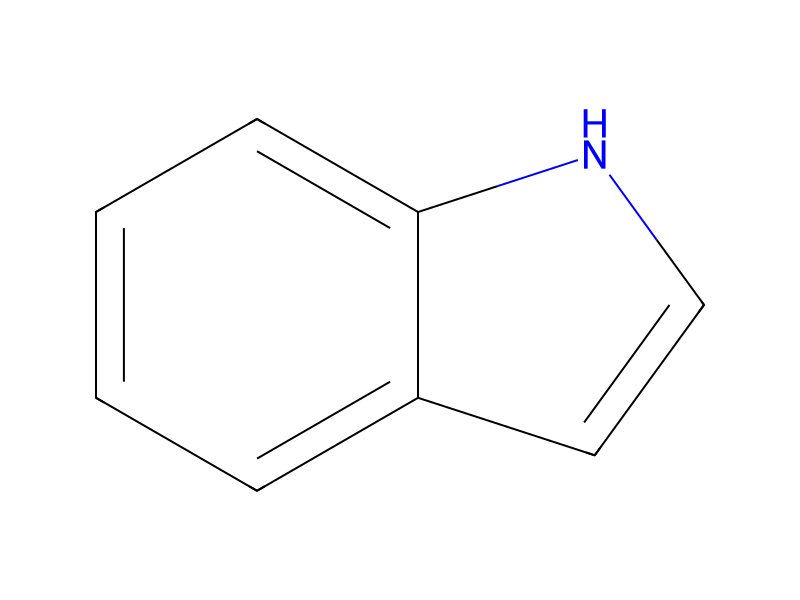
Indole → HCID 15335320, compound
Reaction equation

[Cl:1][C:2]1[CH:3]=[C:4]2[C:8](=[CH:9][CH:10]=1)[N:7]([CH3:11])[C:6]([C:12]([F:15])([F:14])[F:13])=[CH:5]2.ClS([N:20]=[C:21]=O)(=O)=O.N1C2C(=CC=CC=2)C=C1.CN(C)C=O>C(#N)C.C(OCC)C.O>[Cl:1][C:2]1[CH:3]=[C:4]2[C:8](=[CH:9][CH:10]=1)[N:7]([CH3:11])[C:6]([C:12]([F:13])([F:15])[F:14])=[C:5]2[C:21]#[N:20]Participants
8






Procedure
A solution of 5-chloro-1-methyl-2-(trifluoromethyl)indole (1.79 g, 7.7 mmole) in acetonitrile is cooled to 0° C., treated with chlorosulfonylisocyanate (CSI) (1.0 mL 11.5 mmole) stirred until starting indole cannot be observed by thin layer chromatography, treated with 5 mL of dimethylformamide (DMF), stirred for 0.5 hour and diluted with diethyl ether and water. The phases are separated. The organic phase is washed with water, dried over Na2SO4 and concentrated in vacuo. The resultant residue is chromatographed using silica gel and 4:1 hexanes:ethyl acetate as eluent to give the title product as a white solid, 0.99 g (49.7% yield) mp 166°-167.5° C., identified by IR, 1HNMR, 13CNMR, 19FNMR and mass spectral analyses.
Workup
- stirringstirred for 0.5 hour
- customThe phases are separated
- washThe organic phase is washed with water
- dry with materialdried over Na2SO4
- concentrationconcentrated in vacuo
- customThe resultant residue is chromatographed
Sources & evidence
- ORD record
- ord-83e719d4d8fb46499effcd13b54c4bd4
- Source dataset
- uspto-grants-1997_02
- Patent number
- US05599832
Reaction notes
Loading…