Water → 5-Bromo-2-(3,4-dichlorophenoxy)benzaldehyde
Reaction equation

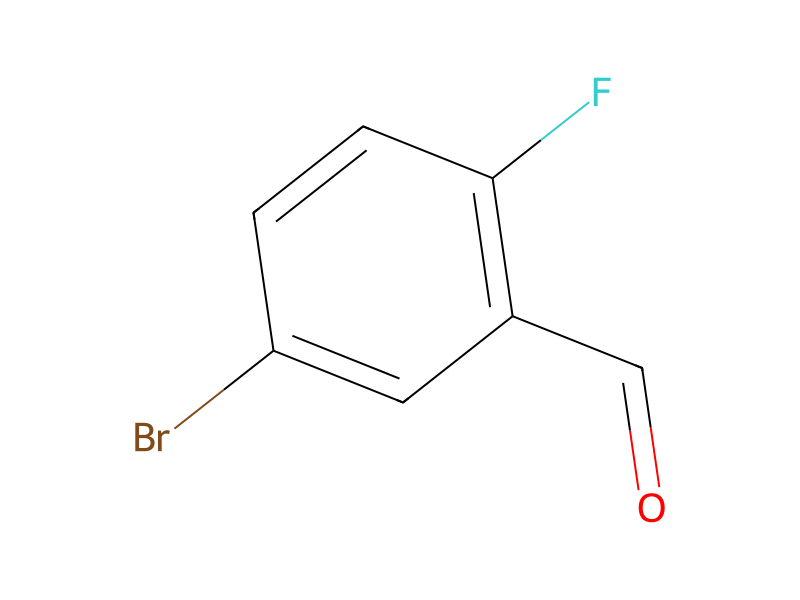
[Br:1][C:2]1[CH:3]=[CH:4][C:5](F)=[C:6]([CH:9]=1)[CH:7]=[O:8].C([O-])([O-])=O.[K+].[K+].[Cl:17][C:18]1[CH:19]=[C:20]([OH:25])[CH:21]=[CH:22][C:23]=1[Cl:24].O>CN(C=O)C>[Br:1][C:2]1[CH:3]=[CH:4][C:5]([O:25][C:20]2[CH:21]=[CH:22][C:23]([Cl:24])=[C:18]([Cl:17])[CH:19]=2)=[C:6]([CH:9]=1)[CH:7]=[O:8]Participants
6





Conditions
- Temperature
- 90 °C
Procedure
To a solution of 5-bromo-2-fluoro-benzaldehyde (5.13 g, 25.4 mmol) in DMF (25 mL) were added K2CO3 (7.15 g, 51.8 mmol) and 3,4-dichloro-phenol (4.67 g, 28.8 mmol). The mixture was heated at 90° C. for 24 h and then was allowed to cool to room temperature (rt). Water was added and the mixture was extracted with Et2O. The combined organic layers were dried (MgSO4) and concentrated. The residue was diluted with DCM and hexanes and the resulting solids were collected by vacuum filtration to provide the desired product (4.74 g, 54%). 1H NMR (CDCl3): 10.36 (s, 1H), 8.06 (d, J=2.5, 1H), 7.67 (dd, J=8.8, 2.6, 1H), 7.46 (d, J=8.8, 1H), 7.17 (d, J=2.8, 1H), 6.92 (dd, J=8.8, 2.8, 1H), 6.84 (d, J=8.8, 1H).
Workup
- temperatureto cool to room temperature (rt)
- extractionthe mixture was extracted with Et2O
- dry with materialThe combined organic layers were dried (MgSO4)
- concentrationconcentrated
- additionThe residue was diluted with DCM and hexanes
- filtrationthe resulting solids were collected by vacuum filtration
Sources & evidence
- ORD record
- ord-c2123d84604242fc8d6495a7e20bed67
- Source dataset
- uspto-grants-2009_01
- Patent number
- US07479493B2
Reaction notes
Loading…