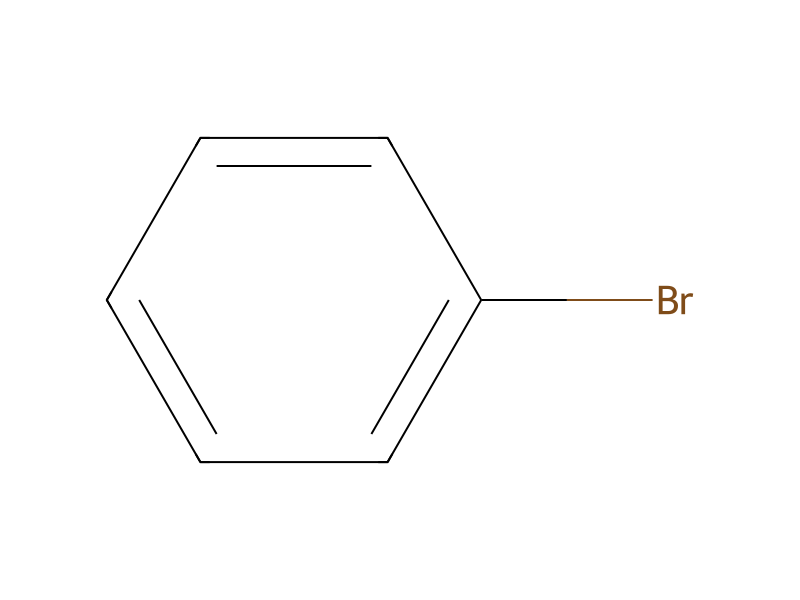
Bromobenzene → HCID 19981420, compound
Reaction equation

C([Sn](CCCC)(CCCC)[C:6]1[S:7][C:8]([C:11]#[C:12][C:13]2[S:14][C:15]3[CH:21]=[CH:20][CH:19]=[CH:18][C:16]=3[CH:17]=2)=[CH:9][CH:10]=1)CCC.Br[C:31]1[CH:36]=[CH:35][CH:34]=[CH:33][CH:32]=1>O1CCCC1.Cl[Pd](Cl)([P](C1C=CC=CC=1)(C1C=CC=CC=1)C1C=CC=CC=1)[P](C1C=CC=CC=1)(C1C=CC=CC=1)C1C=CC=CC=1>[C:31]1([C:6]2[S:7][C:8]([C:11]#[C:12][C:13]3[S:14][C:15]4[CH:21]=[CH:20][CH:19]=[CH:18][C:16]=4[CH:17]=3)=[CH:9][CH:10]=2)[CH:36]=[CH:35][CH:34]=[CH:33][CH:32]=1Participants
Reactant 2

Product 1

Reagents, catalysts & solvents 2


Procedure
To a stirred solution of 1.0 gram (0.0019 mole) of tributyl 5-(benzothien-2-ylethynyl)thien-2-yltin and 0.33 gram (0.0021 mole) of bromobenzene in 10 ml of tetrahydrofuran was added a catalytic amount of bis(triphenylphosphine)palladium(II) chloride. Upon completion of addition, the reaction mixture was warmed to reflux where it was stirred for 18 hours. After this time the reaction mixture was cooled to ambient temperature, and then it was subjected to column chromatography on silica gel. Elution was accomplished with hexane. The appropriate fractions were combined and concentrated under reduced pressure, yielding 0.28 gram of 2-(5-phenylthien-2-ylethynyl)benzothiophene; m.p. 185°-186.5° C. The nmr spectrum was consistent with the proposed structure.
Workup
- additionUpon completion of addition
- temperaturethe reaction mixture was warmed
- temperatureto reflux where it
- washElution
- concentrationconcentrated under reduced pressure
Sources & evidence
- ORD record
- ord-9c9da073e4774351a938160fafd0c926
- Source dataset
- uspto-grants-1991_12
- Patent number
- US05073564
Reaction notes
Loading…