Hydrochloric Acid → 4-Amino-3,6-dihydroxy-1-naphthalenesulfonic acid
Reaction equation

[OH:1][C:2]1[CH:11]=[CH:10][C:9]2[C:4](=[CH:5][C:6]([OH:12])=[CH:7][CH:8]=2)[C:3]=1[N:13]=O.[S:15]([O-:18])([OH:17])=[O:16].[Na+].S(=O)(O)[O-].Cl>O>[OH:1][C:2]1[CH:11]=[C:10]([S:15]([OH:18])(=[O:17])=[O:16])[C:9]2[C:4](=[CH:5][C:6]([OH:12])=[CH:7][CH:8]=2)[C:3]=1[NH2:13]Participants
Reactant 4

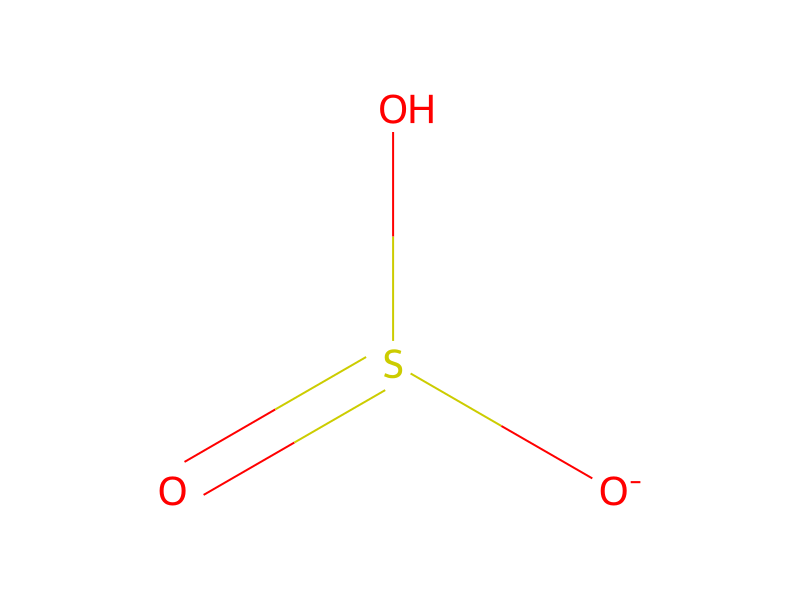


Product 1

Reagents, catalysts & solvents 1

Procedure
In the second reaction stage, the 2,7-dihydroxy-1-nitrosonaphthalene (I), which as a rule is still moist with water and reacts in the tautomeric oxime form (Ia), is first suspended, according to Boninger, Chem. Ber. 27, 3050 (1894), in commercially-available 37% aqueous sodium hydrogen sulfite solution and stirred at about 20°-25° C. until it is completely dissolved. The bisulfite addition compound (IIa) thus formed is not isolated, but the brown reaction solution is acidified with hydrochloric acid and heated to about 25°-60° C., 2,7-dihydroxy-1-aminonaphthalene-4-sulfonic acid (II) being formed by reduction of the nitroso group and aromatization of the cycloaliphatic ring system. The aminonaphtholsulfonic acid (II) is isolated by filtering off with suction the light-gray crystals formed, washing the crystals on the suction filter, first with water and then with methanol and, if desired, drying them. The reaction product thus prepared is used without further purification, if appropriate while still moist, for the next reaction stage. The yield of reaction product II is about 90-95% of theory.
Workup
- customIn the second reaction stage
- dissolutionis completely dissolved
- customthus formed
- customis not isolated
- temperatureheated to about 25°-60° C.
Sources & evidence
- ORD record
- ord-13c5823d50204582bb8507d3f5fe03fc
- Source dataset
- uspto-grants-1991_12
- Patent number
- US05077395
Reaction notes
Loading…