Piperazine → 1-(2-Piperidin-1-yl-ethyl)-piperazine
Reaction equation

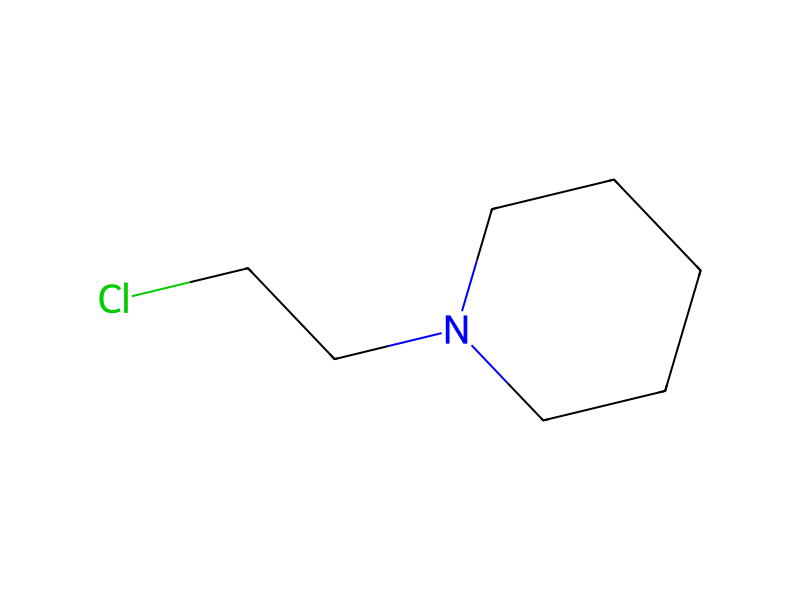
[NH:1]1[CH2:6][CH2:5][NH:4][CH2:3][CH2:2]1.C(=O)([O-])[O-].[Na+].[Na+].Cl[CH2:14][CH2:15][N:16]1[CH2:21][CH2:20][CH2:19][CH2:18][CH2:17]1>C(O)CCCC>[N:16]1([CH2:15][CH2:14][N:1]2[CH2:6][CH2:5][NH:4][CH2:3][CH2:2]2)[CH2:21][CH2:20][CH2:19][CH2:18][CH2:17]1Participants
Reactant 3


Product 1

Reagents, catalysts & solvents 1

Procedure
To a mixture of anhydrous piperazine, 10.0 grams, (0.116 moles) and sodium carbonate (12.3 grams, 0.116 moles) in 70 cc of 1-pentanol brought to the boiling point, is added slowly over a period of four hours, N-(2-chloroethyl)piperidine, (11.3 grams; 0.077 moles) diluted with 150 cc of 1-pentanol. After boiling for an additional period of four hours, the mixture is allowed to cool, it is then filtered and evaporated under reduced pressure. The oily residue is subjected to column chromatography using methanol and concentrated ammonium hydroxide in the ratio of 95:5. The desired product is obtained as an oil, but after standing for a few hours, it solidifies. Melting point is 60°-62° from diisopropyl ether. It forms a picrate: melting point 235°-237° C. (from ethanol); Rf=0.21, (MeOH-NH4OH 9.5:0.5); IR (nujol) max: 3240, 2780, 2760, 1445, 1325, 1300, 1140, 1125, 1105, 865, 770 cm-1.
Workup
- additionis added slowly over a period of four hours
- temperatureto cool
- filtrationit is then filtered
- customevaporated under reduced pressure
Sources & evidence
- ORD record
- ord-bab286f5fb2d4b49980486772ea1422a
- Source dataset
- uspto-grants-1984_07
- Patent number
- US04457931
Reaction notes
Loading…