Dimethyl Sulfate → Benzoic acid, 2-amino-3-chloro-, methyl ester
Reaction equation

[NH2:1][C:2]1[C:10]([Cl:11])=[CH:9][CH:8]=[CH:7][C:3]=1[C:4]([OH:6])=[O:5].[CH2:12](C(C)=O)C(C)C.S(OC)(OC)(=O)=O.C(=O)([O-])[O-].[K+].[K+]>[Br-].C([N+](CCCC)(CCCC)CCCC)CCC.O>[NH2:1][C:2]1[C:10]([Cl:11])=[CH:9][CH:8]=[CH:7][C:3]=1[C:4]([O:6][CH3:12])=[O:5]Participants
Reactant 4



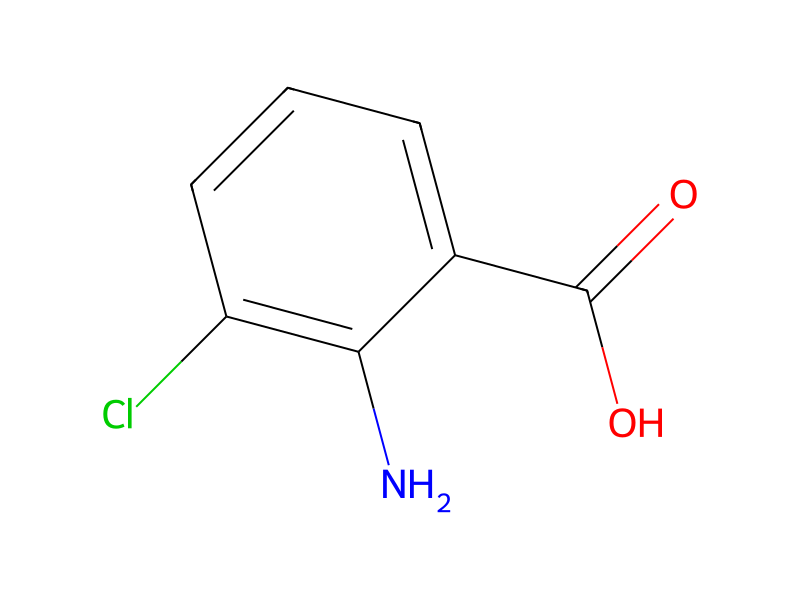
Product 1

Reagents, catalysts & solvents 2


Conditions
- Temperature
- 20 °C
Procedure
85.5 g (0.50 mol) of 2-amino-3-chlorobenzoic acid, 300 ml of MIBK (methyl isobutyl ketone), 16.1 g (0.05 mol) of tetrabutylammonium bromide, and 69.4 g (0.55 mol) of dimethyl sulfate were added to a 1000 ml four-necked flask equipped with a stirrer, a reflux condenser, a thermometer, and a dropping funnel, and a mixture of 76.0 g (0.55 mol) of potassium carbonate and 150 ml of MIBK was added dropwise with stirring at 20° C. Then, the mixture was stirred at room temperature for 1 hour. 250 ml of water was added to the reaction mixture, and the reaction solution was separated at room temperature. Then, the MIBK phase was washed with 250 ml of water, and the MIBK was distilled off under reduced pressure. 88.2 g of methyl 2-amino-3-chlorobenzoate as brown crystals was obtained with a yield of 95%.
Workup
- customequipped with a stirrer, a reflux condenser
- additionwas added dropwise
- stirringThen, the mixture was stirred at room temperature for 1 hour
- customthe reaction solution was separated at room temperature
- washThen, the MIBK phase was washed with 250 ml of water
- distillationthe MIBK was distilled off under reduced pressure
Sources & evidence
- ORD record
- ord-19ebfe0745ff431fbef18f1c83ed9608
- Source dataset
- uspto-grants-2015_04
- Patent number
- US09006477B2
Reaction notes
Loading…