1-Hydroxybenzotriazole → (S)-tert-butyl 2-(6-bromo-1H-benzo[d]imidazol-2-yl)pyrrolidine-1-carboxylate
Reaction equation

CCN=C=NCCCN(C)C.Cl.[Br:13][C:14]1[CH:15]=[C:16]([NH2:21])[C:17]([NH2:20])=[CH:18][CH:19]=1.[C:22]([N:29]1[CH2:36][CH2:35][CH2:34][C@H:30]1[C:31](O)=O)([O:24][C:25]([CH3:28])([CH3:27])[CH3:26])=[O:23].ON1C2C=CC=CC=2N=N1>C(Cl)Cl.O.C(O)(=O)C>[Br:13][C:14]1[CH:19]=[CH:18][C:17]2[N:20]=[C:31]([C@@H:30]3[CH2:34][CH2:35][CH2:36][N:29]3[C:22]([O:24][C:25]([CH3:26])([CH3:28])[CH3:27])=[O:23])[NH:21][C:16]=2[CH:15]=1Participants
Reactant 4


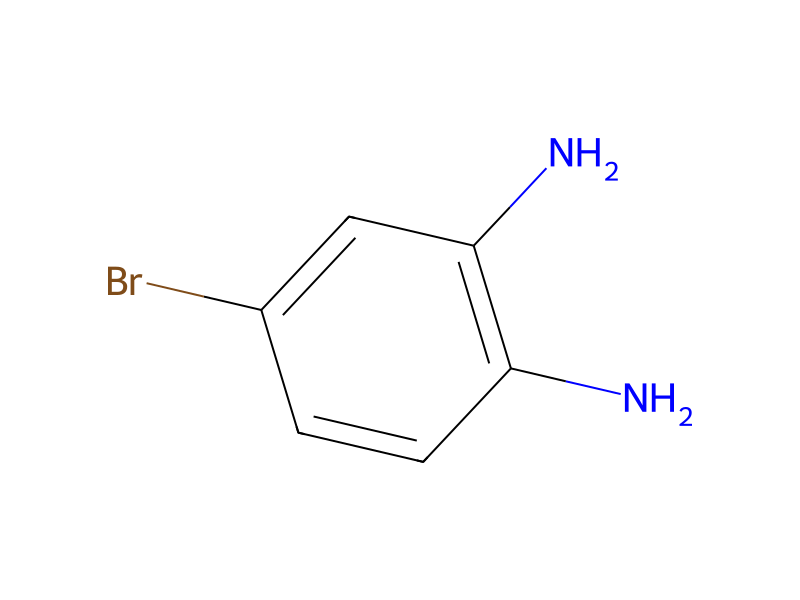

Product 1

Reagents, catalysts & solvents 3



Conditions
- Temperature
- 85 °C
Procedure
EDCI.HCl (16.9 g, 88.0 mmol) was added to a mixture of 4-bromobenzene-1,2-diamine (15.0 g, 80.0 mmol), N-Boc-L-proline (18.13 g, 84.0 mmol) and 1-hydroxybenzotriazole (12.28 g, 80.0 mmol) in CH2Cl2 (500 mL) and stirred at ambient conditions for 16 h. The mixture was then diluted with water. The resulting white precipitate was filtered away and the layers were separated. The organic layer was washed with water, dried (brine; Na2SO4), filtered and concentrated in vacuo to provide a brown foam. Acetic acid (300 mL) was added to the foam and the mixture was heated at 85° C. (bath temperature) for 5 h. The volatile component was removed in vacuo and the residue was dissolved in EtOAc, washed with water and the organic phase was dried (Na2SO4), filtered and concentrated in vacuo. The resultant crude material was submitted to flash chromatography (silica gel; 0-37% EtOAc/CH2Cl2). The partially pure material was re-submitted to flash chromatography (silica gel; 20-35% EtOAc/CH2Cl2) to provide (S)-tert-butyl 2-(6-bromo-1H-benzo[d]imidazol-2-yl)pyrrolidine-1-carboxylate (17.98 g, 61.2% yield) as yellow foam. LC-MS retention time 1.23 min; Calcd. for C16H20BrN3O2: 365.07 Found m/z 368.07 [M+H]+. LC data was recorded on a Shimadzu LC-10AS liquid chromatograph equipped with a Waters Sunfire 5u C18 4.6×50 mm column using a SPD-10AV UV-Vis detector at a detector wave length of 220 nM. The elution conditions employed a flow rate of 4 mL/min, a gradient of 100% Solvent A/0% Solvent B to 0% Solvent A/100% Solvent B, a gradient time of 3 min, a hold time of 1 min and an analysis time of 4 min where Solvent A was 10% acetonitrile/90% water/0.1% TFA and Solvent B was 90% acetonitrile/10% water/0.1% TFA. MS data was determined using a MICROMASS® Platform for LC in electrospray mode. 1H NMR (500 MHz, MeOD) δ ppm 7.59-7.75 (m., 1H), 7.38-7.53 (m, 1H), 7.31-7.38 (m, 1H), 5.04-5.09 (m, 0.3H), 4.94-5.00 (m, 0.7H), 3.68-3.76 (m, 1H), 3.50-3.59 (m, 1H), 2.34-2.51 (m., 1H), 1.95-2.12 (m., 3H), 1.47 (br s, 3H), 1.15 (s, 6H).
Workup
- filtrationThe resulting white precipitate was filtered away
- customthe layers were separated
- washThe organic layer was washed with water
- dry with materialdried (brine; Na2SO4)
- filtrationfiltered
- concentrationconcentrated in vacuo
- customto provide a brown foam
- customThe volatile component was removed in vacuo
- dissolutionthe residue was dissolved in EtOAc
- washwashed with water
- dry with materialthe organic phase was dried (Na2SO4)
- filtrationfiltered
- concentrationconcentrated in vacuo
Sources & evidence
- ORD record
- ord-667bb8ea3c9049209582ad10a9009a4b
- Source dataset
- uspto-grants-2015_04
- Patent number
- US09006455B2
Reaction notes
Loading…