1,2-Dibromoethane → Methyl 5-bromo-3-(2,2,2-trifluoroacetamido)thiophene-2-carboxylate
Reaction equation

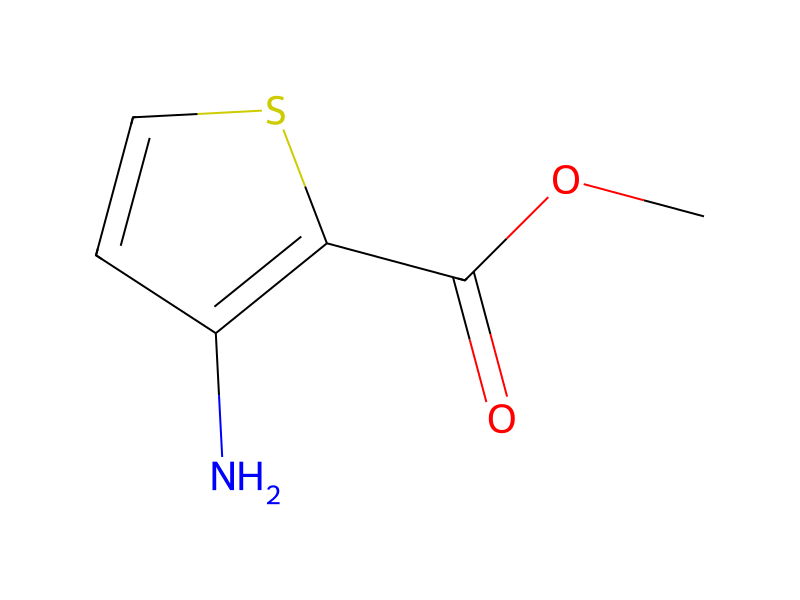
NC1C=CSC=1C(OC)=O.[F:11][C:12]([F:26])([F:25])[C:13]([NH:15][C:16]1[CH:20]=[CH:19][S:18][C:17]=1[C:21]([O:23][CH3:24])=[O:22])=[O:14].FC(F)(F)C(OC(=O)C(F)(F)F)=O.C([Li])CCC.[Br:45]CCBr>>[Br:45][C:19]1[S:18][C:17]([C:21]([O:23][CH3:24])=[O:22])=[C:16]([NH:15][C:13](=[O:14])[C:12]([F:11])([F:25])[F:26])[CH:20]=1Participants
Reactant 5




Product 1

Procedure
In reaction scheme 5 the synthesis of compound B53 is described. The intermediate 3-amino-5-bromo-thiophene-2-carboxylic acid methyl ester (compound B54b) is obtained according to a procedure described in literature (Bioorganic & Medicinal Chemistry Letters 17 (2007) 2535-2539) by conversion of methyl 3-aminothiophene-2-carboxylate to methyl 3-[(trifluoroacetyl)amino]thiophene-2-carboxylate with trifluoroacetic acid anhydride followed by a lithiation/bromination sequence using n-butyllithium and 1,2-dibromoethane to give methyl 5-bromo-3-[(trifluoroacetyl)amino]thiophene-2-carboxylate which is hydrolysed under basic conditions using potassium carbonate to obtain 3-amino-5-bromo-thiophene-2-carboxylic acid methyl ester (compound B54b).
Sources & evidence
- ORD record
- ord-1675147131ea48a098e32004fae6180c
- Source dataset
- uspto-grants-2015_04
- Patent number
- US09018175B2
Reaction notes
Loading…