Cesium carbonate → HCID 90390709, compound
Reaction equation

Cl[C:2]1[CH:7]=[C:6]([C:8]#[N:9])[CH:5]=[C:4]([N:10]2[CH2:15][CH2:14][N:13]([CH:16]3[CH2:21][CH2:20][CH2:19][CH2:18][CH2:17]3)[CH2:12][CH2:11]2)[N:3]=1.[F:22][C:23]([F:34])([F:33])[C:24]1[CH:29]=[CH:28][C:27](B(O)O)=[CH:26][CH:25]=1.C(=O)([O-])[O-].[Cs+].[Cs+].CC(C1C=C(C(C)C)C(C2C=CC=CC=2P(C2CCCCC2)C2CCCCC2)=C(C(C)C)C=1)C>C([O-])(=O)C.[Pd+2].C([O-])(=O)C.O1CCOCC1>[CH:16]1([N:13]2[CH2:14][CH2:15][N:10]([C:4]3[CH:5]=[C:6]([C:8]#[N:9])[CH:7]=[C:2]([C:27]4[CH:28]=[CH:29][C:24]([C:23]([F:34])([F:33])[F:22])=[CH:25][CH:26]=4)[N:3]=3)[CH2:11][CH2:12]2)[CH2:21][CH2:20][CH2:19][CH2:18][CH2:17]1Participants
7
Reactant 4

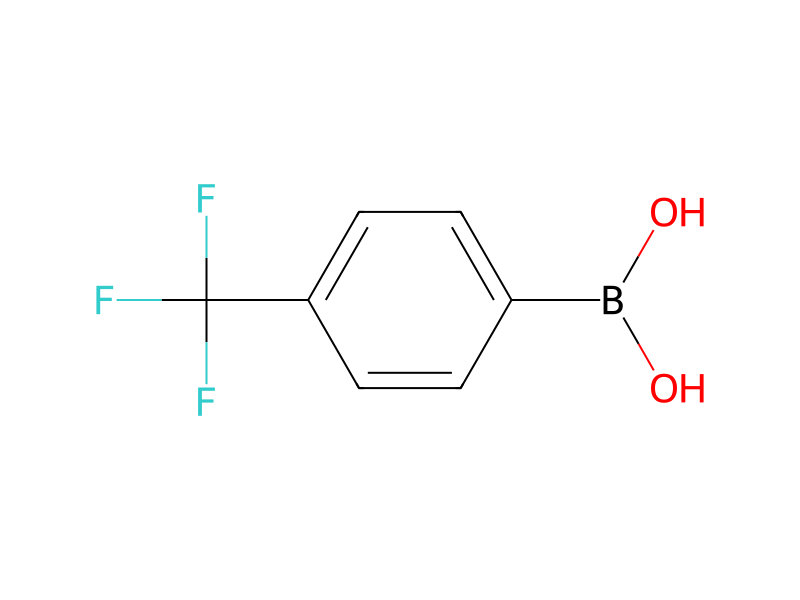


Product 1

Reagents, catalysts & solvents 2


Conditions
- Temperature
- 100 °C
Procedure
The nitrile 25E (2.2 g, 7.2 mmol), 4-trifluoromethylphenylboronic acid (2.05 g, 1.1 mol eq), palladium acetate (45 mg), cesium carbonate (4.5 g, 2 mol eq), and XPhos (190 mg) were mixed, placed under a nitrogen atmosphere and dioxane (10 mL) was added. The mixture was heated at 100° C. overnight. After cooling, the mixture was filtered through a celite pad, washed with dioxane (2×20 mL) and concentrated under reduced pressure. The residue was a yellow oil. 1HNMR (DMSO, 200 MHz) δ 1.14 (bm, 4H), 1.59 (bm, 1H), 1.75 (bm, 4H), 2.26 (bm, 2H), 2.58 (m, 4H), 3.62 (m, 4H), 7.33 (s, 1H), 7.66 (s, 1H), 7.82 (d, 2H, J=8.2), 8.28 (d, 2H, J=8.2).
Workup
- temperatureAfter cooling
- filtrationthe mixture was filtered through a celite pad
- washwashed with dioxane (2×20 mL)
- concentrationconcentrated under reduced pressure
Sources & evidence
- ORD record
- ord-e5cbf86200dd4299a88fa9611349969a
- Source dataset
- uspto-grants-2016_08
- Patent number
- US09409864B2
Reaction notes
Loading…