(2R,3S,4R,5R)-2,3,4,5,6-pentahydroxyhexanal → HCID 178418489, compound
Reaction equation

[O:1]=[CH:2][C@@H:3]([C@H:5]([C@@H:7]([C@@H:9](CO)[OH:10])[OH:8])[OH:6])[OH:4].O=C[C@@H]([C@H]([C@@H](CO)O)O)O>C(O)C>[CH2:2]([OH:1])[C@@H:3]([C@H:5]([C@@H:7]([CH2:9][OH:10])[OH:8])[OH:6])[OH:4]Participants
Reactant 2

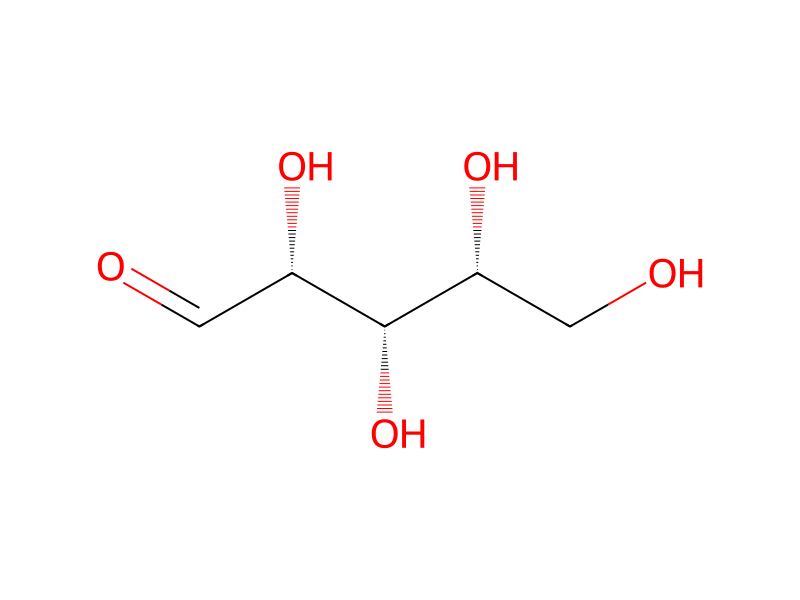
Product 1
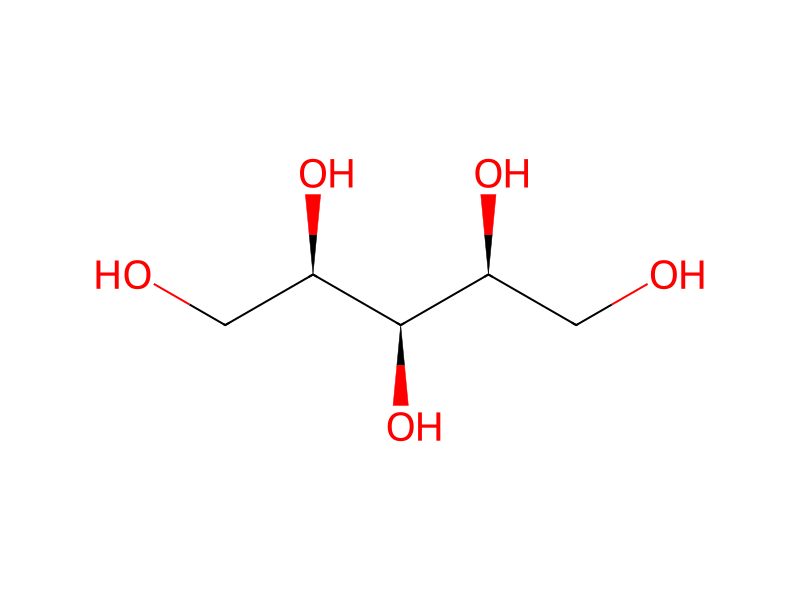
Reagents, catalysts & solvents 1

Procedure
After 25 hours, strain CD804 (Ex. 4D) had consumed 15 g/L D-xylose and produced about 4.7 g/L of xylitol and 1 g/L of ethanol from the flask containing the glucose isomerase. In contrast, strains CD805 (Ex. 5C) and CD806 (Ex. 6B) had each consumed 25 g/L D-xylose in the presence of glucose isomerase. Strain CD805 produced in this time about 1.9 g/L of xylitol and 7.1 g/L of ethanol. Strain CD806 produced in this time about 1.8 g/L of xylitol and 6.8 g/L of ethanol. Xylulose seems to be consumed by the strains at very high rates, something which is not observed in S. cerevisiae. The non-oxidative pentose phosphate pathway controls the fermentation rate of xylulose but not of xylose in S. cerevisiae TMB3001. FEM Yeast Res. 2002 August; 2(3):277-82. Johansson B, Hahn-Hagerdal B). Without added glucose isomerase, each of strains CD804, CD805 and CD806 consumed xylose very slowly.
Sources & evidence
- ORD record
- ord-485b6a731b2649ca99dd2e14977e1106
- Source dataset
- uspto-grants-2016_08
- Patent number
- US09410158B2
Reaction notes
Loading…