Cyclopentylamine → 5-Bromo-2-chloro-N-cyclopentyl-4-pyrimidinamine
Reaction equation

[Br:1][C:2]1[C:3](Cl)=[N:4][C:5]([Cl:8])=[N:6][CH:7]=1.[CH:10]1([NH2:15])[CH2:14][CH2:13][CH2:12][CH2:11]1.CCN(C(C)C)C(C)C>CCO>[Br:1][C:2]1[C:3]([NH:15][CH:10]2[CH2:14][CH2:13][CH2:12][CH2:11]2)=[N:4][C:5]([Cl:8])=[N:6][CH:7]=1Participants
5
Reactant 3


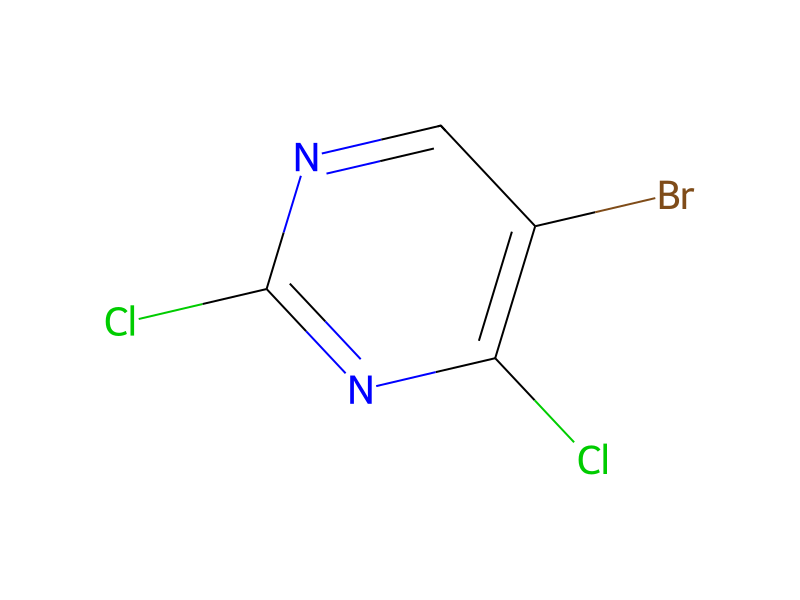
Product 1

Reagents, catalysts & solvents 1

Procedure
In a large sealed tube is added 5-bromo-2,4-dichloropyrimidine (3 g, 13.2 mmol) in 100 mL of EtOH. Then cyclopentyl amine (1.95 mL, 19.75 mmol) and N,N′-diisopropylethylamine (3.36 mL, 19.8 mmol) are added to the solution at rt. The solution is then stirred rt overnight. Solvent is evaporated and the crude is purified using silica gel chromatography (15% ethyl acetate/85% hexane) to give (5-bromo-2-chloro-pyrimidin-4-yl)-cyclopentyl-amine as a white solid (3.25 g, 89%). MS (ESI) m/z 278.4 (M+H)+
Workup
- customSolvent is evaporated
- customthe crude is purified
Sources & evidence
- ORD record
- ord-b054df713e974e4dbd1c3e608b3b20e7
- Source dataset
- uspto-grants-2016_08
- Patent number
- US09416136B2
Reaction notes
Loading…