Ammonium Chloride → tert-Butyl 4-(4-((4-(2-(3-(2-amino-2-oxoethyl)pyrazin-2-yl)ethyl)-5-(trifluoromethyl)pyrimidin-2-yl)amino)phenyl)piperidine-1-carboxylate
Reaction equation

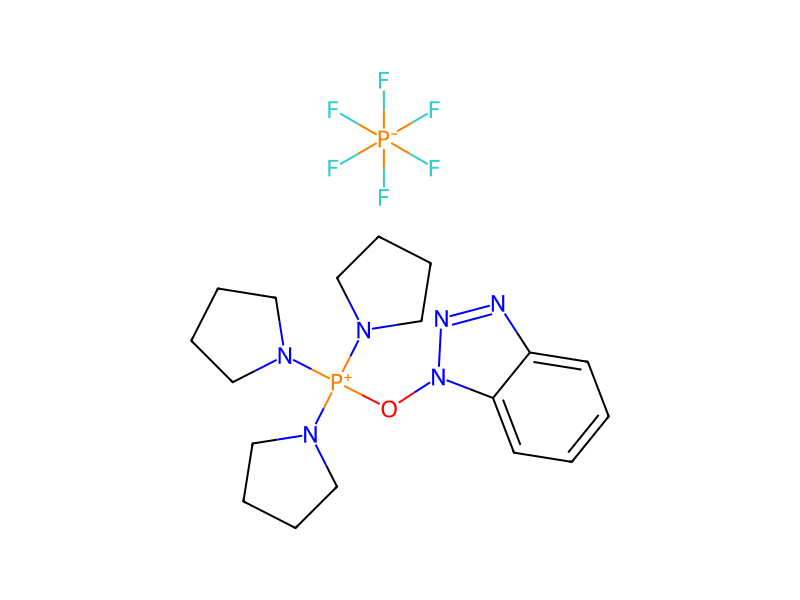
C(O[C:4](=[O:44])[CH2:5][C:6]1[C:7]([CH2:12][CH2:13][C:14]2[C:19]([C:20]([F:23])([F:22])[F:21])=[CH:18][N:17]=[C:16]([NH:24][C:25]3[CH:30]=[CH:29][C:28]([CH:31]4[CH2:36][CH2:35][N:34]([C:37]([O:39][C:40]([CH3:43])([CH3:42])[CH3:41])=[O:38])[CH2:33][CH2:32]4)=[CH:27][CH:26]=3)[N:15]=2)=[N:8][CH:9]=[CH:10][N:11]=1)C.O.[OH-].[Li+].[Cl-].[NH4+].C1C=CC2N(O)N=[N:56]C=2C=1.C1CN([P+](ON2N=NC3C=CC=CC2=3)(N2CCCC2)N2CCCC2)CC1.F[P-](F)(F)(F)(F)F.CCN(C(C)C)C(C)C>C1COCC1.O.CO>[NH2:56][C:4](=[O:44])[CH2:5][C:6]1[C:7]([CH2:12][CH2:13][C:14]2[C:19]([C:20]([F:21])([F:23])[F:22])=[CH:18][N:17]=[C:16]([NH:24][C:25]3[CH:30]=[CH:29][C:28]([CH:31]4[CH2:32][CH2:33][N:34]([C:37]([O:39][C:40]([CH3:42])([CH3:43])[CH3:41])=[O:38])[CH2:35][CH2:36]4)=[CH:27][CH:26]=3)[N:15]=2)=[N:8][CH:9]=[CH:10][N:11]=1Participants
Reactant 6





Product 1

Reagents, catalysts & solvents 3



Procedure
tert-Butyl 4-(4-((4-(2-(3-(2-ethoxy-2-oxoethyl)pyrazin-2-yl)ethyl)-5-(trifluoromethyl)pyrimidin-2-yl)amino)phenyl)piperidine-1-carboxylate (I103) (142 mg, 0.231 mmol) was dissolved in THF (10 mL) and methanol (5 mL) then a solution of lithium hydroxide monohydrate (48.0 mg, 1.16 mmol) in water (2.5 mL) was added. The mixture was stirred at room temperature for 17 hours, and then concentrated. The residue was evaporated twice from toluene then dissolved in DMF (20 mL) and ammonium chloride (62 mg, 1.2 mmol), HOBt (47 mg, 0.35 mmol), PyBOP (181 mg, 0.347 mmol) and DIPEA (0.161 mL, 0.924 mmol) were added. After two hours the mixture was quenched with water (1 mL), concentrated and the residue partitioned between 1:3 saturated brine:water (30 mL) and ethyl acetate (20 mL). The aqueous phase was washed with ethyl acetate (3×20 mL) then the combined ethyl acetate phases were washed with brine (50 mL), dried (sodium sulfate) and evaporated. The residue was chromatographed (12 g silica cartridge, 20-100% ethyl acetate/petroleum benzine 40-60° C. then 100% ethyl acetate for 10 column volumes) to give the title compound (I104) (66.2 mg, 49% yield) as a colourless syrup; 1H NMR (400 MHz, d4-MeOD) δ 8.40 (d, J=0.6 Hz, 1H), 8.29 (d, J=2.6 Hz, 1H), 8.24 (d, J=2.5 Hz, 1H), 7.40 (d, J=8.3 Hz, 2H), 7.09-7.01 (m, 2H), 4.10 (d, J=13.3 Hz, 2H), 3.81-3.75 (m, 2H), 3.34-3.23 (m, 4H), 2.76 (br s), 2.58 (tt, J=12.0, 3.4 Hz, 1H), 1.71 (d, J=12.2 Hz, 2H), 1.47 (ddd, J=25.5, 12.8, 4.3 Hz, 2H), 1.38 (s, 9H). LCMS Method C: 6.17 min; m/z 586.1 [M+H]+, 530.1 [M-tBu+2H]+, 486.1 [M-Boc+2H]+; m/z 584.2 [M−H]−.
Workup
- concentrationconcentrated
- customThe residue was evaporated twice from toluene
- dissolutionthen dissolved in DMF (20 mL)
- customAfter two hours the mixture was quenched with water (1 mL)
- concentrationconcentrated
- customthe residue partitioned between 1:3 saturated brine
- washThe aqueous phase was washed with ethyl acetate (3×20 mL)
- washthe combined ethyl acetate phases were washed with brine (50 mL)
- dry with materialdried (sodium sulfate)
- customevaporated
- customThe residue was chromatographed (12 g silica cartridge, 20-100% ethyl acetate/petroleum benzine 40-60° C.
Sources & evidence
- ORD record
- ord-2ed7b7706c534fccac621c2507426b58
- Source dataset
- uspto-grants-2016_08
- Patent number
- US09421205B2
Reaction notes
Loading…