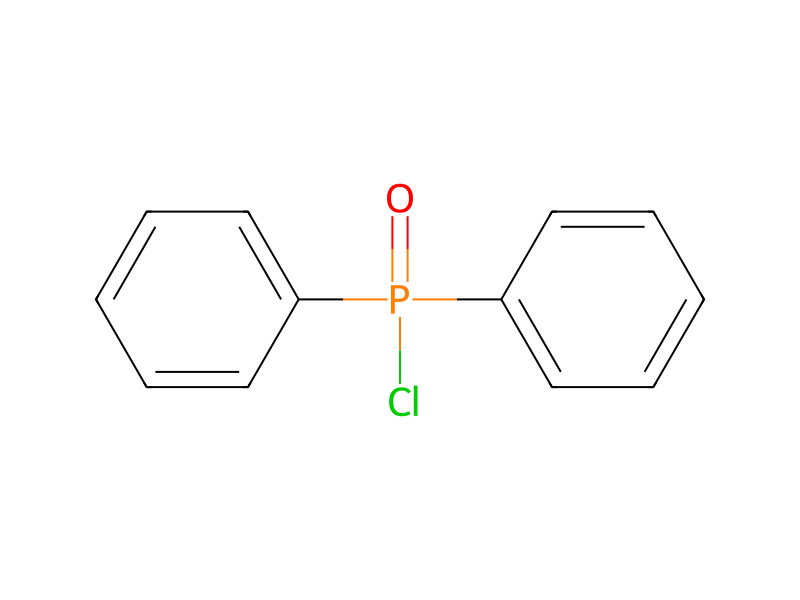
Diphenylphosphinic chloride → O-(Diphenylphosphinyl)hydroxylamine
Reaction equation

Cl.[NH2:2][OH:3].C(=O)(O)[O-].[Na+].[C:9]1([P:15](Cl)([C:17]2[CH:22]=[CH:21][CH:20]=[CH:19][CH:18]=2)=[O:16])[CH:14]=[CH:13][CH:12]=[CH:11][CH:10]=1>O.O1CCOCC1.O1CCOCC1>[NH2:2][O:3][P:15](=[O:16])([C:17]1[CH:18]=[CH:19][CH:20]=[CH:21][CH:22]=1)[C:9]1[CH:14]=[CH:13][CH:12]=[CH:11][CH:10]=1Participants
6





Conditions
- Temperature
- 2.5 °C
Procedure
Into a 500-mL three neck round-bottom flask, was placed a solution of hydroxylamine hydrochloride (30.0 g, 432 mmol) in H2O/dioxane (90/45 mL). The solution was cooled to 0-5° C., then sodium bicarbonate (36.5 g, 434 mmol) was added portion-wise over 10 min and the mixture was stirred at 0-5° C. for 30 min. A solution of diphenylphosphinoyl chloride (41.0 g, 173 mmol) in dioxane (45 mL) was added drop-wise at 0-5° C. over 30 min, then the resulting mixture was stirred for an additional 2 h at ambient temperature. The resulting solids were collected by filtration and washed with water (200 mL), NaOH (0.25 M, 200 mL) and PE (200 mL). The product was dried to yield the title compound as a white solid (20 g, crude).
Workup
- stirringthe resulting mixture was stirred for an additional 2 h at ambient temperature
- filtrationThe resulting solids were collected by filtration
- washwashed with water (200 mL), NaOH (0.25 M, 200 mL) and PE (200 mL)
- customThe product was dried
Sources & evidence
- ORD record
- ord-812142c8ee7940e78e4f6d2daef391c2
- Source dataset
- uspto-grants-2016_08
- Patent number
- US09428502B2
Reaction notes
Loading…