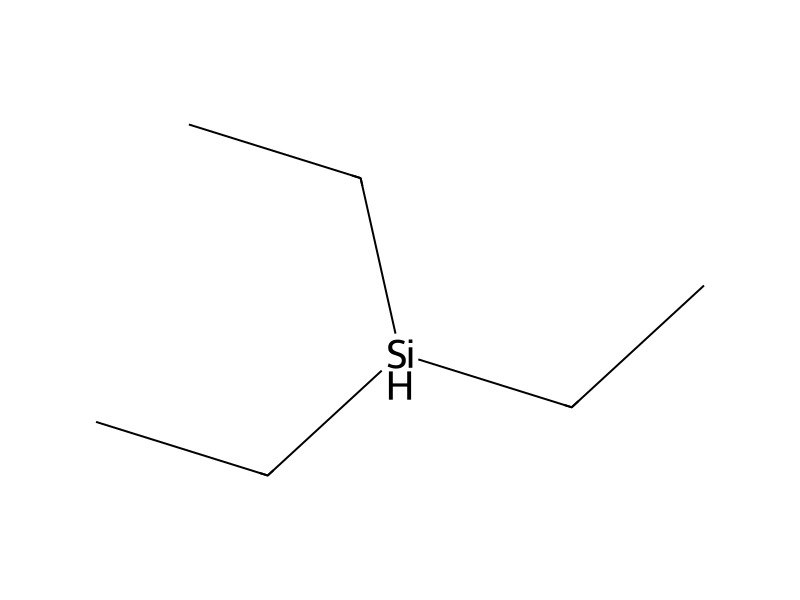
Triethylsilane → Ethyl 4-oxobutanoate
Reaction equation

Cl[C:2](=[O:10])[CH2:3][CH2:4][C:5]([O:7][CH2:8][CH3:9])=[O:6].C([SiH](CC)CC)C>O1CCCC1>[O:10]=[CH:2][CH2:3][CH2:4][C:5]([O:7][CH2:8][CH3:9])=[O:6]Participants
4
Reactant 2

Product 1

Reagents, catalysts & solvents 1

Procedure
Into a 500-mL round-bottom flask, which was purged and maintained with an inert atmosphere of nitrogen, was placed a solution of ethyl 4-chloro-4-oxobutanoate (12 g, 72.91 mmol) in tetrahydrofuran (200 mL). The system was purged with nitrogen and palladium on carbon (2 g) was added to the reaction. This was followed by the addition of triethylsilane (16.5 mL, 103.20 mmol) dropwise with stirring at room temperature. The reaction mixture was stirred for 2 h at room temperature. The solids were filtered off and the filtrate was concentrated under reduced pressure to give 18 g (crude) of the title compound as a light yellow solid.
Workup
- customInto a 500-mL round-bottom flask, which was purged
- temperaturemaintained with an inert atmosphere of nitrogen
- customThe system was purged with nitrogen and palladium on carbon (2 g)
- additionwas added to the reaction
- stirringThe reaction mixture was stirred for 2 h at room temperature
- filtrationThe solids were filtered off
- concentrationthe filtrate was concentrated under reduced pressure
Sources & evidence
- ORD record
- ord-425e2a3edc704192b4860c310ad95f6e
- Source dataset
- uspto-grants-2016_08
- Patent number
- US09428502B2
Reaction notes
Loading…