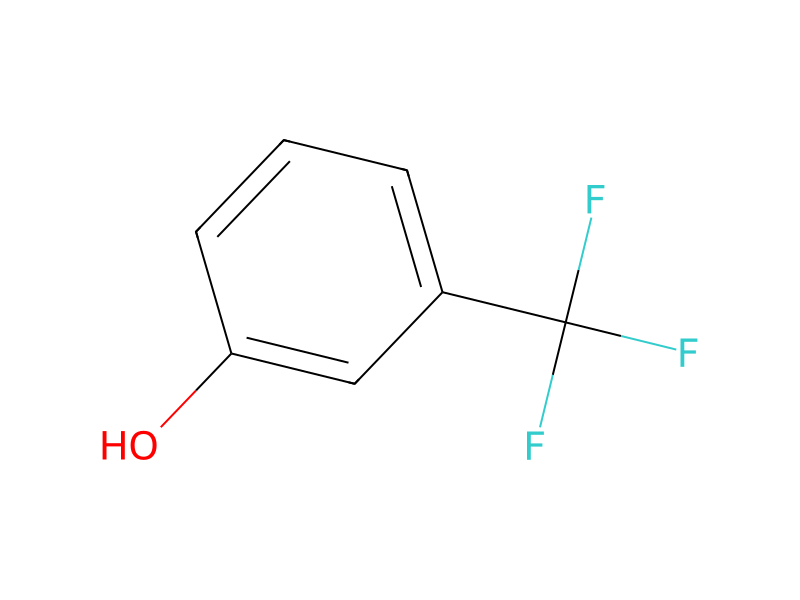
3-(Trifluoromethyl)phenol → 2-(3-Trifluoromethylphenoxy)-6-benzyloxypyridine
Reaction equation

[CH2:1]([O:8][C:9]1[CH:14]=[CH:13][CH:12]=[C:11](Cl)[N:10]=1)[C:2]1[CH:7]=[CH:6][CH:5]=[CH:4][CH:3]=1.[F:16][C:17]([F:26])([F:25])[C:18]1[CH:19]=[C:20]([OH:24])[CH:21]=[CH:22][CH:23]=1>[H-].[Na+].CN(C)C=O>[F:16][C:17]([F:25])([F:26])[C:18]1[CH:19]=[C:20]([CH:21]=[CH:22][CH:23]=1)[O:24][C:11]1[CH:12]=[CH:13][CH:14]=[C:9]([O:8][CH2:1][C:2]2[CH:7]=[CH:6][CH:5]=[CH:4][CH:3]=2)[N:10]=1Participants
5




Procedure
The procedure of Example 4a) was also used to introduce the 3-trifluoromethyl phenoxy group by reaction of 2-benzyloxy-6-chloropyridine (5 g; 23 mmols) from a) above with 3-trifluoromethylphenol (3.3 g; 0.018 mols) using dry sodium hydride (0.55 g) and dry dimethylformamide (200 ml) as solvent, with a 1 hour reflux stage. 2-(3-Trifluoromethylphenoxy)-6-benzyloxypyridine (4.9 g; 51%) was obtained as a yellow oil following solvent extraction (chloroform/water--500 ml; 50/50), and chromatography plus distillation of the organic layer.
Workup
- additionto introduce the 3-trifluoromethyl phenoxy group
- temperaturewith a 1 hour reflux stage
Sources & evidence
- ORD record
- ord-9e8aa03260f841788284981f9f77c884
- Source dataset
- uspto-grants-1994_12
- Patent number
- US05374604
Reaction notes
Loading…