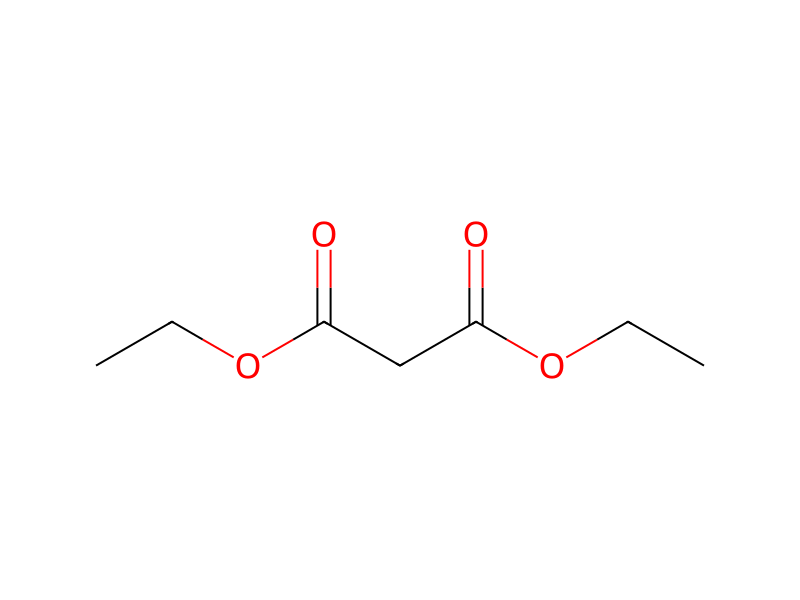
Diethyl Malonate → Diethyl [3-(3-pyridyl)-propyl]malonate
Reaction equation

[C:1]([O:9][CH2:10][CH3:11])(=[O:8])[CH2:2][C:3]([O:5][CH2:6][CH3:7])=[O:4].[Na].Br.[N:14]1[CH:19]=[CH:18][CH:17]=[C:16]([CH2:20][CH2:21][CH2:22]Br)[CH:15]=1>C(O)C>[N:14]1[CH:19]=[CH:18][CH:17]=[C:16]([CH2:20][CH2:21][CH2:22][CH:2]([C:3]([O:5][CH2:6][CH3:7])=[O:4])[C:1]([O:9][CH2:10][CH3:11])=[O:8])[CH:15]=1Participants
Reactant 3


Product 1

Reagents, catalysts & solvents 1

Procedure
To a solution of 48 mL (0.37 mole) of diethyl malonate in 960 mL ethanol is added 14.03 g (0.61 mole) sodium metal and the mixture is stirred until all of the metal dissolved. The solution is heated to reflux and a solution of 80.04 g (0.28 mole) of 3-(3-pyridyl)-propyl bromide hydrobromide in 960 mL ethanol is added rapidly and the mixture is maintained at reflux for 10 hours. The reaction mixture is evaporated and the residue is taken up in 400 mL of 1N aqueous hydrochloric acid and washed with 400 mL hexane. The aqueous phase is adjusted to pH 8 using solid sodium bicarbonate. The mixture is then extracted with methylene chloride (3×200 mL). Combined organic extracts are dried (MgSO4), filtered and evaporated to dryness to give diethyl [3-(3-pyridyl)-propyl]-malonate as an oil.
Workup
- dissolutiondissolved
- temperatureThe solution is heated
- temperatureto reflux
- temperaturethe mixture is maintained
- temperatureat reflux for 10 hours
- customThe reaction mixture is evaporated
- washwashed with 400 mL hexane
- extractionThe mixture is then extracted with methylene chloride (3×200 mL)
- dry with materialCombined organic extracts are dried (MgSO4)
- filtrationfiltered
- customevaporated to dryness
Sources & evidence
- ORD record
- ord-d679882bf6634677a11492f3bc56fc09
- Source dataset
- uspto-grants-1991_06
- Patent number
- US05025025
Reaction notes
Loading…