3-Phenylprop-2-En-1-Ol → Dicinnamyl ether
Reaction equation

[C:1]([O:4][CH2:5][CH:6]=[CH:7][C:8]1[CH:13]=[CH:12][CH:11]=[CH:10][CH:9]=1)(=O)[CH3:2].C(O)C=[CH:16][C:17]1[CH:22]=[CH:21][CH:20]=[CH:19][CH:18]=1>O>[CH2:1]([O:4][CH2:5][CH:6]=[CH:7][C:8]1[CH:13]=[CH:12][CH:11]=[CH:10][CH:9]=1)[CH:2]=[CH:16][C:17]1[CH:22]=[CH:21][CH:20]=[CH:19][CH:18]=1Participants
4
Reactant 2
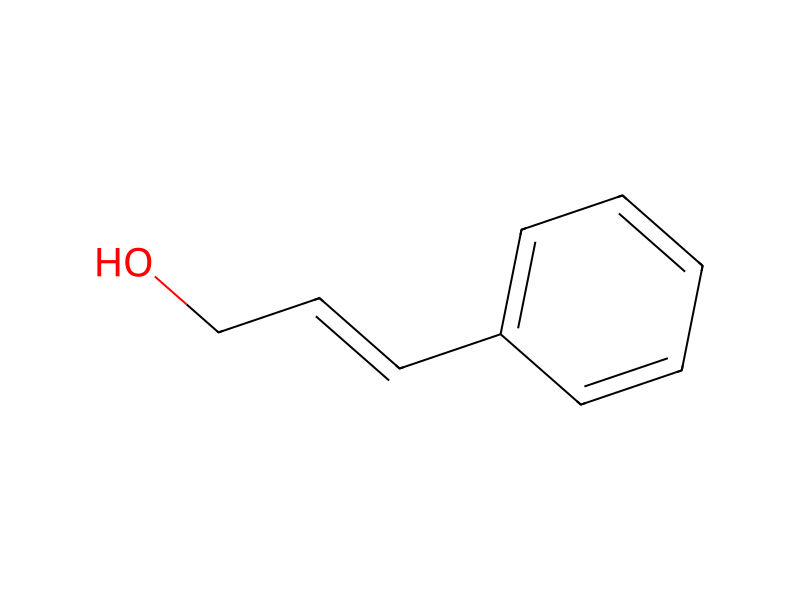

Product 1

Reagents, catalysts & solvents 1

Procedure
As apparent from Table 4, it is found that the carboxylic acid esters, each of which produces a water-soluble carboxylic acid by hydrolysis, are hydrolyzed with a high efficiency, and alcohols can be obtained with a high yield. In addition, in a hydrolysis reaction shown in the bottom portion of Table 4 in which cinnamyl acetate is used as the carboxylic acid ester, since cinnamyl alcohol, which is a reaction product, may be dimerized to form dicinnamyl ether as a by-product in some cases, a reaction was taken place at a low temperature of 40° C.; however, an alcohol could be obtained with a high yield of 93%. In the above table, the yield shown in the parentheses indicates the yield of dicinnamyl ether.
Workup
- customby hydrolysis
- customcan be obtained with a high yield
- customIn addition, in a hydrolysis reaction
Sources & evidence
- ORD record
- ord-fe922a4942ba40e48397283f08e7828d
- Source dataset
- uspto-grants-2015_12
- Patent number
- US09206107B2
Reaction notes
Loading…