Benzaldehyde → Dibenzylamine
Reaction equation

[CH:1](=O)[C:2]1[CH:7]=[CH:6][CH:5]=[CH:4][CH:3]=1.[CH2:9]([NH2:16])[C:10]1[CH:15]=[CH:14][CH:13]=[CH:12][CH:11]=1.C(O)=O>[Ir].CO>[CH2:1]([NH:16][CH2:9][C:10]1[CH:15]=[CH:14][CH:13]=[CH:12][CH:11]=1)[C:2]1[CH:7]=[CH:6][CH:5]=[CH:4][CH:3]=1Participants
Reactant 3


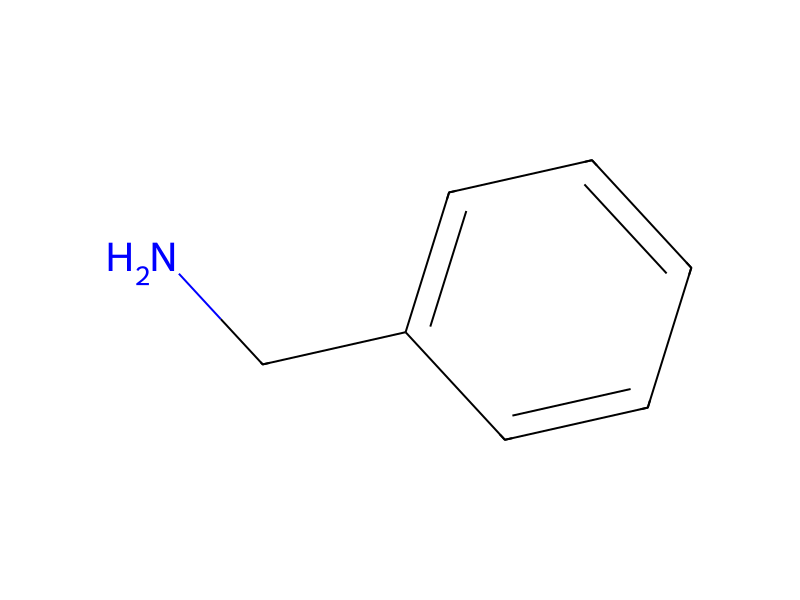
Product 1

Reagents, catalysts & solvents 2


Conditions
- Temperature
- 60 °C
Procedure
Under an argon-gas atmosphere, 5 mL of dehydrated methanol, 505 μL (5.0 mmol) of benzaldehyde (MW: 106.12), 545 μL (5.0 mmol) of benzylamine (MW: 107.15), 566 μL (15.0 mmol) of formic acid (MW: 46.43), and 5.90 mg (0.01 mmol, S/C=500) of the iridium catalyst Ir-7 (MW: 590.13) were introduced in a 20-mL Schlenk tube, and the mixture was stirred while heating at 60° C. for 1.5 hr. After distillation of the solvent, a saturated sodium hydrogen carbonate solution was added, then a product was extracted with methylene chloride, the organic layer was washed with water, and the product was dried with sodium sulfate. The drying agent was removed by filtration and the methylene chloride was distilled away to give a crude product dibenzylamine. Its conversion rate was 100% based on NMR measurement, with 95% of dibenzylamine, 3% of tribenzylamine, and 2% of benzyl alcohol.
Workup
- distillationAfter distillation of the solvent
- additiona saturated sodium hydrogen carbonate solution was added
- extractiona product was extracted with methylene chloride
- washthe organic layer was washed with water
- dry with materialthe product was dried with sodium sulfate
- customThe drying agent was removed by filtration
- distillationthe methylene chloride was distilled away
Sources & evidence
- ORD record
- ord-1e71bb293d284e399d2593d458179be2
- Source dataset
- uspto-grants-2015_12
- Patent number
- US09211533B2
Reaction notes
Loading…