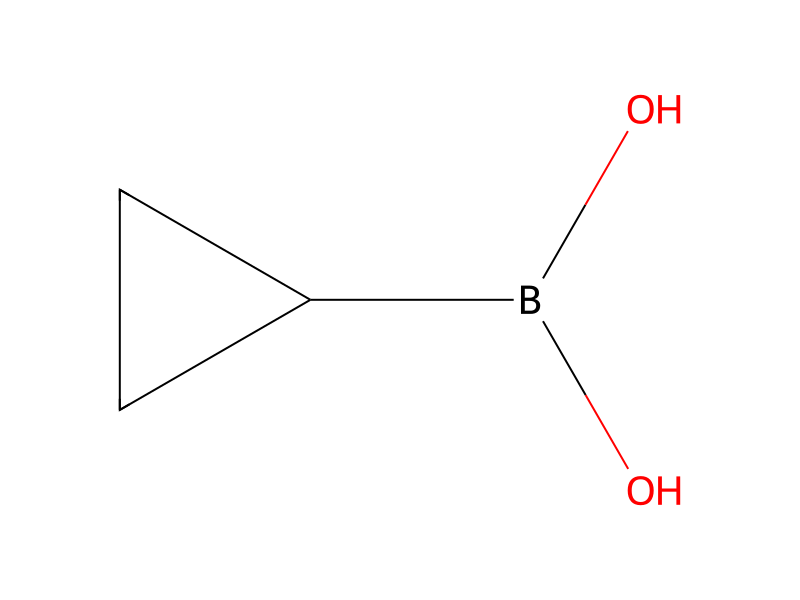
Cyclopropylboronic acid → HCID 117737393, compound
Reaction equation

[Cl:1][C:2]1[CH:3]=[C:4]([N:11]2[C:20]3[C:15](=[CH:16][C:17]([S:21]([NH:24][C:25]4[CH:29]=[CH:28][O:27][N:26]=4)(=[O:23])=[O:22])=[CH:18][CH:19]=3)[CH:14]=[CH:13][C:12]2=[O:30])[C:5]([O:9][CH3:10])=[N:6][C:7]=1Cl.[CH:31]1(B(O)O)[CH2:33][CH2:32]1>CCOC(C)=O.CS(C)=O>[Cl:1][C:2]1[CH:3]=[C:4]([N:11]2[C:20]3[C:15](=[CH:16][C:17]([S:21]([NH:24][C:25]4[CH:29]=[CH:28][O:27][N:26]=4)(=[O:22])=[O:23])=[CH:18][CH:19]=3)[CH:14]=[CH:13][C:12]2=[O:30])[C:5]([O:9][CH3:10])=[N:6][C:7]=1[CH:31]1[CH2:33][CH2:32]1Participants
Reactant 2

Product 1

Reagents, catalysts & solvents 2


Conditions
- Temperature
- 50 °C
Procedure
A 20-mL vial was charged with 1-(5,6-dichloro-2-methoxypyridin-3-yl)-N-(isoxazol-3-yl)-2-oxo-1,2-dihydroquinoline-6-sulfonamide (200 mg, 0.428 mmol), cyclopropyl boronic acid (66.2 μl, 0.856 mmol), and (1,1′-bis(diphenylphosphino)ferrocene)dichloropalladium(II) (62.6 mg, 0.086 mmol) then purged with nitrogen. The reaction vessel was then sequentially charged with dioxane (3.2 mL) and an aqueous solution of sodium carbonate (1.1 mL, 1.9 M) via syringe. The vial was sealed with a PTFE line cap and the resultant red reaction mixture was heated to 50° C. After 12 h, the reaction mixture was allowed to cool to ambient temperature and an aqueous solution of 1.0 N HCL (5 mL) was added and the mixture diluted with EtOAc (5 mL). The layers were separated and the aqueous layer was extracted with EtOAc (3×5 mL). The combined organic layers were washed with brine (25 mL), dried over anhydrous sodium sulfate, filtered, and concentrated under reduced pressure to furnish a brown oil, which was dissolved in DMSO (2 mL) filtered through a 0.2 micron filter and purified by reverse-phase HPLC (Waters XBridge Prep Shield RP18 10 μm OBD 19×100 mm) gradient, 20 to 75% MeCN in water (containing 0.1% trifluoroacetic acid as an additive), flow rate 40 mL/min to afford 1-(5-chloro-6-cyclopropyl-2-methoxy-3-pyridinyl)-N-3-isoxazolyl-2-oxo-1,2-dihydro-6-quinolinesulfonamide (85 mg, 0.180 mmol, 42.0% yield) as a white amorphous solid. 1H NMR (400 MHz, CHLOROFORM-d) δ ppm 8.23 (d, J=1.76 Hz, 1 H) 8.13 (d, J=1.97 Hz, 1 H) 7.74-7.80 (m, 2 H) 7.46 (s, 1 H) 6.82 (d, J=9.64 Hz, 1 H) 6.75 (d, J=9.02 Hz, 1 H) 6.56 (d, J=1.66 Hz, 1 H) 3.76 (s, 3 H) 2.41-2.61 (m, 1 H) 1.14-1.23 (m, 2 H) 1.09 (dd, J=8.09, 3.21 Hz, 2 H). m/z (ESI) 473.0 (M+H)+.
Workup
- customthen purged with nitrogen
- additionThe reaction vessel was then sequentially charged with dioxane (3.2 mL)
- customThe vial was sealed with a PTFE line
- customcap
- customthe resultant red reaction mixture
- temperatureto cool to ambient temperature
- additionan aqueous solution of 1.0 N HCL (5 mL) was added
- customThe layers were separated
- extractionthe aqueous layer was extracted with EtOAc (3×5 mL)
- washThe combined organic layers were washed with brine (25 mL)
- dry with materialdried over anhydrous sodium sulfate
- filtrationfiltered
- concentrationconcentrated under reduced pressure
- customto furnish a brown oil, which
- filtrationfiltered through a 0.2 micron
- filtrationfilter
- custompurified by reverse-phase HPLC (Waters XBridge Prep Shield RP18 10 μm OBD 19×100 mm) gradient, 20 to 75% MeCN in water (
- additioncontaining 0.1% trifluoroacetic acid as an additive), flow rate 40 mL/min
Sources & evidence
- ORD record
- ord-f5344c6466604629a4616cba0bd61881
- Source dataset
- uspto-grants-2015_12
- Patent number
- US09212182B2
Reaction notes
Loading…