Sodium hydride → 5-Bromo-3-(2,4-dimethylpyridin-3-yloxy)picolinonitrile
Reaction equation

[CH3:1][C:2]1[C:7]([OH:8])=[C:6]([CH3:9])[CH:5]=[CH:4][N:3]=1.[H-].[Na+].[Br:12][C:13]1[CH:14]=[C:15]([N+]([O-])=O)[C:16]([C:19]#[N:20])=[N:17][CH:18]=1.[NH4+].[Cl-]>O.CN(C=O)C>[Br:12][C:13]1[CH:14]=[C:15]([O:8][C:7]2[C:2]([CH3:1])=[N:3][CH:4]=[CH:5][C:6]=2[CH3:9])[C:16]([C:19]#[N:20])=[N:17][CH:18]=1Participants
7
Reactant 4


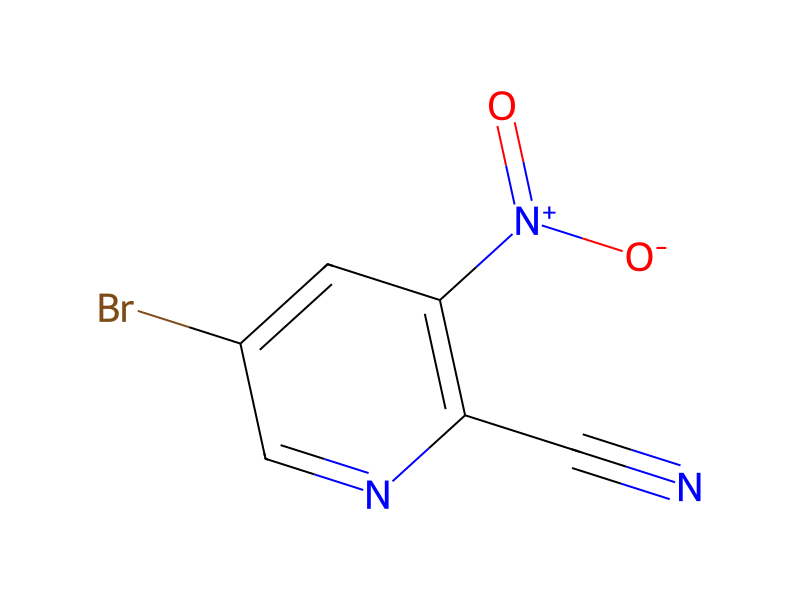

Product 1

Reagents, catalysts & solvents 2


Procedure
A flask was charged with 2,4-dimethylpyridin-3-ol (9.0 g, 73.1 mmol) and DMF (80 mL) was added. Sodium hydride (2.03 g, 80.4 mmol) was added and the reaction was stirred for 15 minutes. 5-Bromo-3-nitropicolinonitrile (16.7 g, 73.1 mmol) was added and the reaction was stirred for 25 minutes. The reaction mixture was poured into 600 mL saturated NH4Cl and 600 mL water and then filtered, washed with water and a small amount of hexanes, and dried over high vacuum to provide 5-bromo-3-(2,4-dimethylpyridin-3-yloxy)picolinonitrile (20.5 g, 67.4 mmol, 92.2% yield) as a light tan solid.
Workup
- additionwas added
- stirringthe reaction was stirred for 25 minutes
- filtrationfiltered
- washwashed with water
- dry with materiala small amount of hexanes, and dried over high vacuum
Sources & evidence
- ORD record
- ord-ed0225753da04d579d82ae8be5b0c3c4
- Source dataset
- uspto-grants-2012_07
- Patent number
- US08212045B2
Reaction notes
Loading…