Diethylamine → Methyl 3-amino-4-(2,6-dichlorophenylethynyl)-benzoate
Reaction equation

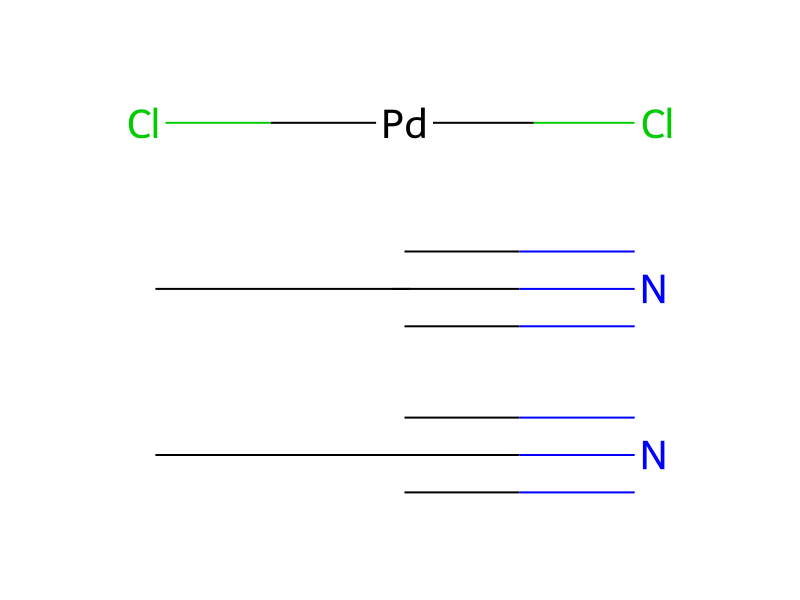
[NH2:1][C:2]1[CH:3]=[C:4]([CH:9]=[CH:10][C:11]=1I)[C:5]([O:7][CH3:8])=[O:6].[Cl:13][C:14]1[CH:19]=[CH:18][CH:17]=[C:16]([Cl:20])[C:15]=1[C:21]#[CH:22].C(NCC)C>C(#N)C.C(#N)C.C(#N)C.[Pd](Cl)Cl.[Cu]I>[NH2:1][C:2]1[CH:3]=[C:4]([CH:9]=[CH:10][C:11]=1[C:22]#[C:21][C:15]1[C:14]([Cl:13])=[CH:19][CH:18]=[CH:17][C:16]=1[Cl:20])[C:5]([O:7][CH3:8])=[O:6]Participants
7
Reactant 3



Product 1

Reagents, catalysts & solvents 3


Conditions
- Temperature
- 120 °C
Procedure
A mixture of methyl 3-amino-4-iodobenzoate (604 mg, 2.18 mmol) (from Example 3-4), 2,6-dichlorophenylacetylene (447 mg, 2.61 mmol), palladium (II) chloride bis(acetonitrile) (23 mg, 89 μmol), diethylamine (449 μL, 318 mg, 4.35 mmol), and copper (I) iodide (21 mg, 110 μmol) in acetonitrile (10 mL) was heated for 35 min at 120° C. in a microwave apparatus. The mixture was filtered, and the filtrate concentrated, then chromatographed using a gradient of 0-30% heptane/ethyl acetate to give methyl 3-amino-4-(2,6-dichlorophenylethynyl)-benzoate.
Workup
- filtrationThe mixture was filtered
- concentrationthe filtrate concentrated
- customchromatographed
Sources & evidence
- ORD record
- ord-ccc0e3edc632437db918d2fabb7704a6
- Source dataset
- uspto-grants-2012_07
- Patent number
- US08222248B2
Reaction notes
Loading…