Dimethylformamide → 9H-Fluorene, 9,9-bis(4-methoxyphenyl)-
Reaction equation

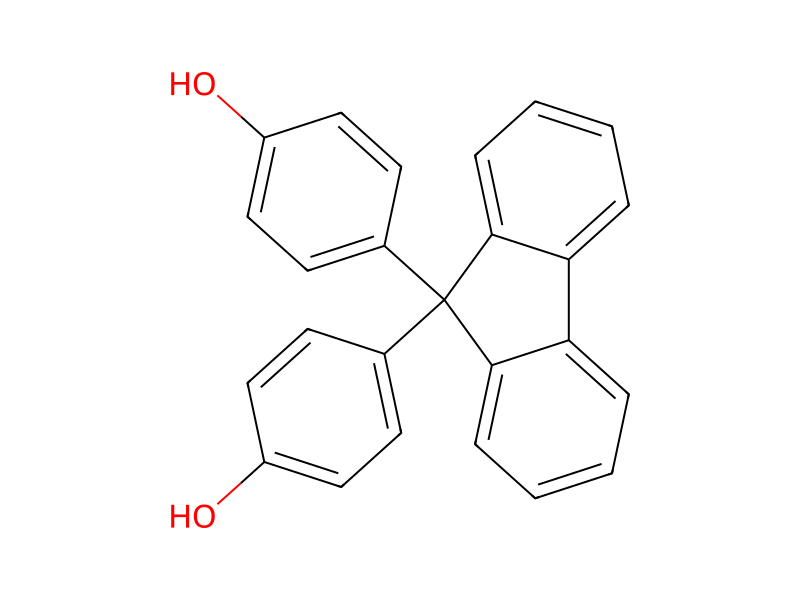
O[C:2]1[CH:7]=[CH:6][C:5]([C:8]2([C:21]3[CH:26]=[CH:25]C(O)=[CH:23][CH:22]=3)[C:20]3[CH:19]=[CH:18][CH:17]=[CH:16][C:15]=3[C:14]3[C:9]2=[CH:10][CH:11]=[CH:12][CH:13]=3)=[CH:4][CH:3]=1.CN(C)[CH:30]=[O:31].[C:33](=[O:36])([O-])[O-].[K+].[K+].[CH3:39]I>CO.C(C(C)=O)C(C)C>[CH3:39][O:36][C:33]1[CH:25]=[CH:26][C:21]([C:8]2([C:5]3[CH:6]=[CH:7][C:2]([O:31][CH3:30])=[CH:3][CH:4]=3)[C:20]3[CH:19]=[CH:18][CH:17]=[CH:16][C:15]=3[C:14]3[C:9]2=[CH:10][CH:11]=[CH:12][CH:13]=3)=[CH:22][CH:23]=1Participants






Conditions
- Temperature
- 10 °C
Procedure
To a 500 mL four-necked flask, 35.0 g (0.10 mole) of 9,9-bis(4-hydroxyphenyl)-9H-fluorene and 300 mL of dimethylformamide were fed, and the resulting mixture was allowed to dissolve, followed by addition of 63.6 g (0.46 mole) of potassium carbonate to the resulting solution. The resulting mixture was cooled to 10° C. and 31.2 g (0.22 mole) of methyl iodide was added thereto dropwise, followed by stirring the mixture for 6 hours. To this mixture, 500 mL of methyl isobutyl ketone was fed, and the resulting mixture was washed 3 times with 400 mL of water, followed by concentrating thereof under reduced pressure to obtain a crude product. To this crude product, 300 mL of methyl isobutyl ketone was added and the crude product was allowed to dissolve under heat, followed by addition of 300 mL of methanol, collection of yielded crystals by filtration and drying thereof to obtain 29.7 g of 9,9-bis(4-methoxyphenyl)-9H-fluorene. The yield was 79%. On the other hand, 4.77 g (0.02 mole) of bis(4-fluorophenyl)sulfoxide and 30 ml of dimethylformamide were fed to a 100 mL four-necked flask and allowed to dissolve, followed by addition of 2.20 g (0.055 mole) of sodium hydroxide and 1.60 g (4.0×10⁻³ mole) of tetrabutylammonium hydrosulfate to the resulting solution and replacement of the atmosphere with nitrogen. To this mixture, 6.91 g (0.05 mole) of 2,4-dimethylbenzenethiol was added dropwise, and the resulting mixture was heated to 48° C. and stirred for 11 hours. To this mixture, 500 mL of ethyl acetate was fed, and the resulting mixture was washed 4 times with 300 mL of water and concentrated under reduced pressure to yield crystals which were then collected by filtration and dried to obtain 5.67 g of bis[4-(2,4-dimethylphenylsulfanyl)phenyl)sulfoxide. The yield was 60%. By following the same procedure as in Example 1 except that 2.28 g (0.0048 mole) of bis[4-(2,4-dimethylphenylsulfanyl)phenyl]sulfoxide was used instead of bis(hydroxyphenyl)sulfoxide and that 1.75 g (0.0048 mole) of 9,9-bis(4-methoxyphenyl)-9H-fluorene was used instead of 9,9-bis(4-hydroxyphenyl)-9H-fluorene, 3.48 g of trifluoromethanesulfonate bis[4-(2,4-dimethylbenzenesulfanyl)phenyl][2-methoxy-[5-(9H-fluorene-9-yl(4-methoxyphenyl)methyl)phenyl]sulfonium was obtained. The yield was 74%. To a 50 mL four-necked flask, 0.99 g (1.0×10⁻³ mole) of the obtained compound and 10.0 g of acetic acid were fed and the compound was allowed to dissolve, followed by addition of 0.0165 g (5.0×10⁻⁵ mole) of sodium tungstate dihydrate and dropwise addition of 0.91 g (8.0×10⁻³ mole) of 30% aqueous hydrogen peroxide solution to the resulting solution, heating of the resulting mixture to 60° C. and stirring thereof for 3 hours. To the mixture, 30 mL of methyl isobutyl ketone was fed, and the resulting mixture was washed 3 times with 30 mL of water, followed by concentrating thereof under reduced pressure. The MALDI-TOFMASS of this crude product was measured to find a peak at 1307.22, so that coexistence of single fluorene bisphenol molecule wherein sulfoniation occurred at 2 positions (compound No. 11B) was confirmed. This product was dissolved into 30 mL of methyl isobutyl ketone again and 30 mL of p-xylene was added to the resulting solution, followed by collection of yielded crystals by filtration and drying thereof to obtain the compound No. 11. The yielded amount was 0.051 g, and the yield was 4.8%.
Workup
- dissolutionto dissolve
- washthe resulting mixture was washed 3 times with 400 mL of water
- concentrationby concentrating
- customunder reduced pressure to obtain a crude product
- dissolutionto dissolve
- temperatureunder heat
- customdrying
Sources & evidence
- ORD record
- ord-a294cab919214211b7144a6ae88a66e9
- Source dataset
- uspto-grants-2012_07
- Patent number
- US08227624B2
Reaction notes
Loading…