Potassium t-amylate → Naphthalene
Reaction equation

[CH3:1][CH2:2][C:3]([O-])([CH3:5])[CH3:4].[K+]>[Br-].C([P+](C1C=CC=CC=1)(C1C=CC=CC=1)C1C=CC=CC=1)C.C1COCC1>[CH:2]1[C:3]2[C:5](=[CH:4][CH:3]=[CH:5][CH:4]=2)[CH:1]=[CH:2][CH:1]=1Participants
Reactant 1

Product 1

Reagents, catalysts & solvents 2
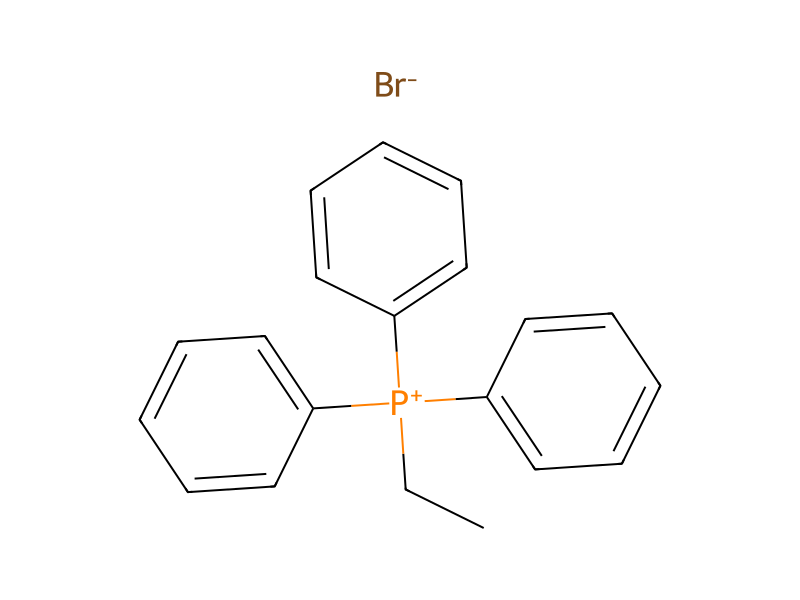

Conditions
- Temperature
- 0 °C
Procedure
To the suspension of ethyl triphenyl phosphonium bromide (3.72 g, 10.0 mmol) in anhydrous THF (8 ml), a solution is added by drops of potassium tert-amylate (5.5 ml, 9.3 mmol, 1.7 M solution in toluene) using a syringe at room temperature. After 1 hour, the reaction mixture is cooled to a temperature of 0° C., a solution is added of aldehyde with formula 20 (1.68 g, 7.16 mmol), the cooling bath is removed, and mixing is carried out for 3 hours at room temperature. Then, the reaction mixture is diluted with cyclohexane (30 ml), the sediment is filtered off, and the solvent is evaporated at reduced pressure. The residue is chromatographed on silica gel (cyclohexane), obtaining a naphthalene derivative with formula 21 in the form of an oil as a mixture of isomers E:Z=1.82:1 (1.66 g, 94%).
Workup
- customat room temperature
- customthe cooling bath is removed
- additionmixing
- waitis carried out for 3 hours at room temperature
- additionThen, the reaction mixture is diluted with cyclohexane (30 ml)
- filtrationthe sediment is filtered off
- customthe solvent is evaporated at reduced pressure
- customThe residue is chromatographed on silica gel (cyclohexane)
Sources & evidence
- ORD record
- ord-3a384bd2c29d4ee79fdb01d91db97ac9
- Source dataset
- uspto-grants-2015_07
- Patent number
- US09074028B2
Reaction notes
Loading…