Acetic Acid → Ethyl 2-(1-cyclobutylpiperidin-4-yl)acetate
Reaction equation

[C:1]1(=O)[CH2:4][CH2:3][CH2:2]1.C(O)(=O)C.[CH2:10]([O:12][C:13](=[O:21])[CH2:14][CH:15]1[CH2:20][CH2:19][NH:18][CH2:17][CH2:16]1)[CH3:11].C(O[BH-](OC(=O)C)OC(=O)C)(=O)C.[Na+].C(=O)(O)[O-].[Na+]>ClCCl>[CH2:10]([O:12][C:13](=[O:21])[CH2:14][CH:15]1[CH2:20][CH2:19][N:18]([CH:1]2[CH2:4][CH2:3][CH2:2]2)[CH2:17][CH2:16]1)[CH3:11]Participants
Reactant 5



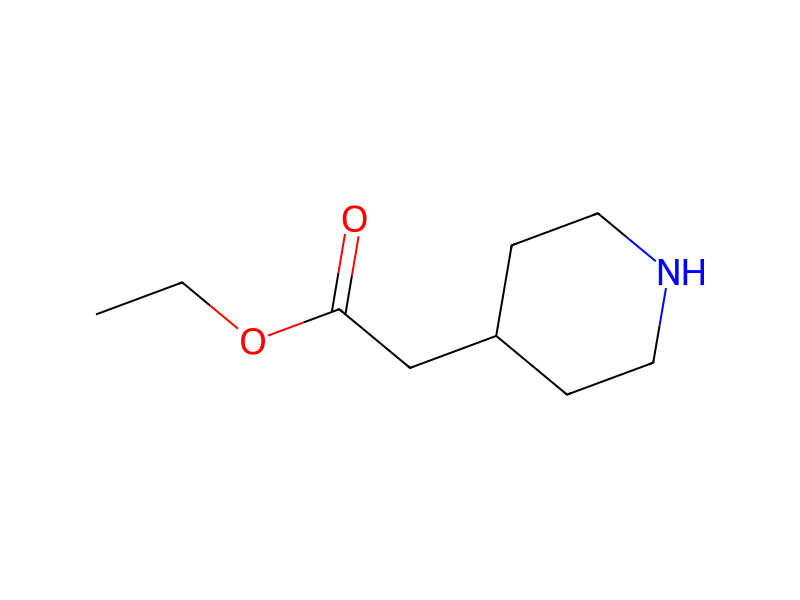

Product 1

Reagents, catalysts & solvents 1

Conditions
- Temperature
- 0 °C
Procedure
A mixture of cyclobutanone (0.3 mL, 3.94 mmol) in acetic acid (0.19 mL, 3.28 mmol) was added to a stirred solution of piperidin-4-yl acetic acid ethyl ester (562 mg, 3.28 mmol, obtained in above step) in dichloromethane cooled at 0° C. Solid sodium triacetoxyborohydride (1.39 grams, 7.2 mmol) was added portion wise over a period of 15 minutes. The reaction mixture was gradually warmed to room temperature and stirred for 16 hours. The reaction mixture was cooled to 0° C. and basified with saturated sodium bicarbonate solution (pH: 7.5). The two layers were separated, the organic layer was washed with brine, dried over anhydrous sodium sulphate and the volatiles were removed under reduced pressure to obtain (1-Cyclobutyl piperidin-4-yl) acetic acid ethyl ester (652 mg).
Workup
- temperatureThe reaction mixture was gradually warmed to room temperature
- customThe two layers were separated
- washthe organic layer was washed with brine
- dry with materialdried over anhydrous sodium sulphate
- customthe volatiles were removed under reduced pressure
Sources & evidence
- ORD record
- ord-97a57def674c47bcb8e867a61bf32727
- Source dataset
- uspto-grants-2015_07
- Patent number
- US09079894B2
Reaction notes
Loading…