Chloroacetyl chloride → 1-(2-Chloroacetyl)indoline
Reaction equation

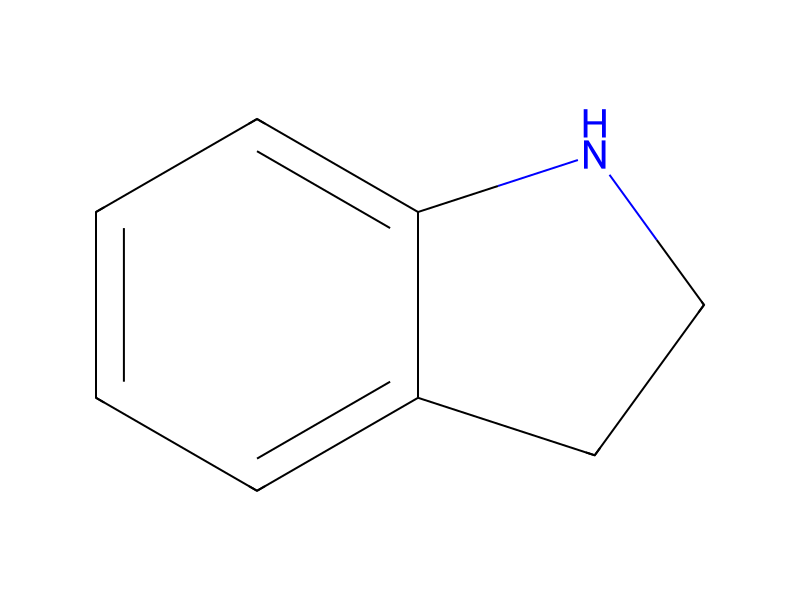
[Cl:1][CH2:2][C:3](Cl)=[O:4].[NH:6]1[C:14]2[C:9](=[CH:10][CH:11]=[CH:12][CH:13]=2)[CH2:8][CH2:7]1.C(N(CC)CC)C>ClCCl>[Cl:1][CH2:2][C:3]([N:6]1[C:14]2[C:9](=[CH:10][CH:11]=[CH:12][CH:13]=2)[CH2:8][CH2:7]1)=[O:4]Participants
5
Reactant 3


Product 1

Reagents, catalysts & solvents 1

Procedure
Chloroacetyl chloride (0.37 ml, 4.6 mmol) was added to a solution of indoline (0.47 ml, 4.19 mmol) and triethylamine (TEA; 0.70 ml, 5.03 mmol) in dichloromethane (DCM; 15 ml). The mixture was stirred for 3 hrs at room temperature (RT) and then quenched with water (5 ml). The phases were separated and the aqueous layer was extracted with DCM (3×5 ml). The combined organic layers were dried over MgSO4 and concentrated to a dark brown residue, 1 g (quantitative), which was used for the next step without further purification.
Workup
- customquenched with water (5 ml)
- customThe phases were separated
- extractionthe aqueous layer was extracted with DCM (3×5 ml)
- dry with materialThe combined organic layers were dried over MgSO4
- concentrationconcentrated to a dark brown residue, 1 g (quantitative), which
- customwas used for the next step without further purification
Sources & evidence
- ORD record
- ord-ce42ced3ad2f41aa8ec7a01c4c3cff10
- Source dataset
- uspto-grants-2015_07
- Patent number
- US09079895B2
Reaction notes
Loading…