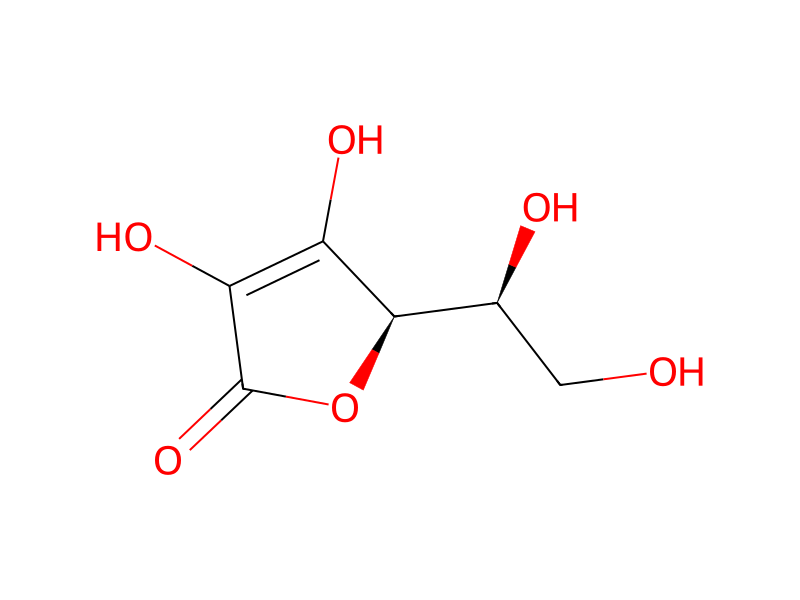
1-Butanol → L-Ascorbic Acid
Reaction equation

[CH2:1]([OH:13])[C@H:2]([OH:12])[C@@H:3](O)[C@H:4]([OH:10])[C:5]([C:7]([OH:9])=[O:8])=[O:6].C(O)CCC.S(=O)(=O)(O)O.ClC(Cl)=C(Cl)Cl.Cl>O>[O:8]=[C:7]1[O:9][C@H:3]([C@H:2]([CH2:1][OH:13])[OH:12])[C:4]([OH:10])=[C:5]1[OH:6]Participants
Reactant 5





Product 1
Reagents, catalysts & solvents 1

Conditions
- Temperature
- 85 °C
Procedure
742 g (3.75 mol) of anhydrous 2-keto-L-gulonic acid were suspended in 1.5 l (17 mol) of n-butanol and, after addition of 8 g of concentrated sulfuric acid, the mixture was evacuated to 200 mbar. After heating to 85° C., 1.1 l of water-containing n-butanol were distilled off after 2 hours. The viscous, golden-yellow-colored melt was mixed with 906 ml (8.9 mol) of perchloroethylene and rearranged at 72 to 75° C. for 17 hours after addition of 84 ml of conc. hydrochloric acid. The precipitated L-ascorbic acid was filtered off with suction, washed with n-butanol and dried in vacuo. 588 g (88%) of a pale gray crude product having a purity of 98.5% were obtained. The crude product dissolved in water. After clarifying filtration, a colorless solution was obtained from which it was possible to isolate L-ascorbic acid in a manner known from the literature. The residue (0.9%) consisted mainly of carbon.
Workup
- customthe mixture was evacuated to 200 mbar
- addition1.1 l of water-containing n-butanol
- distillationwere distilled off after 2 hours
- filtrationThe precipitated L-ascorbic acid was filtered off with suction
- washwashed with n-butanol
- customdried in vacuo
- customwere obtained
- filtrationfiltration
- customa colorless solution was obtained from which it
Sources & evidence
- ORD record
- ord-07cb4d8fe16b4f61af768633939d4157
- Source dataset
- uspto-grants-2001_03
- Patent number
- US06197977B1
Reaction notes
Loading…